
After-hours office cleaning: minimize disruption for your business
After-hours office cleaning: minimize disruption for your business
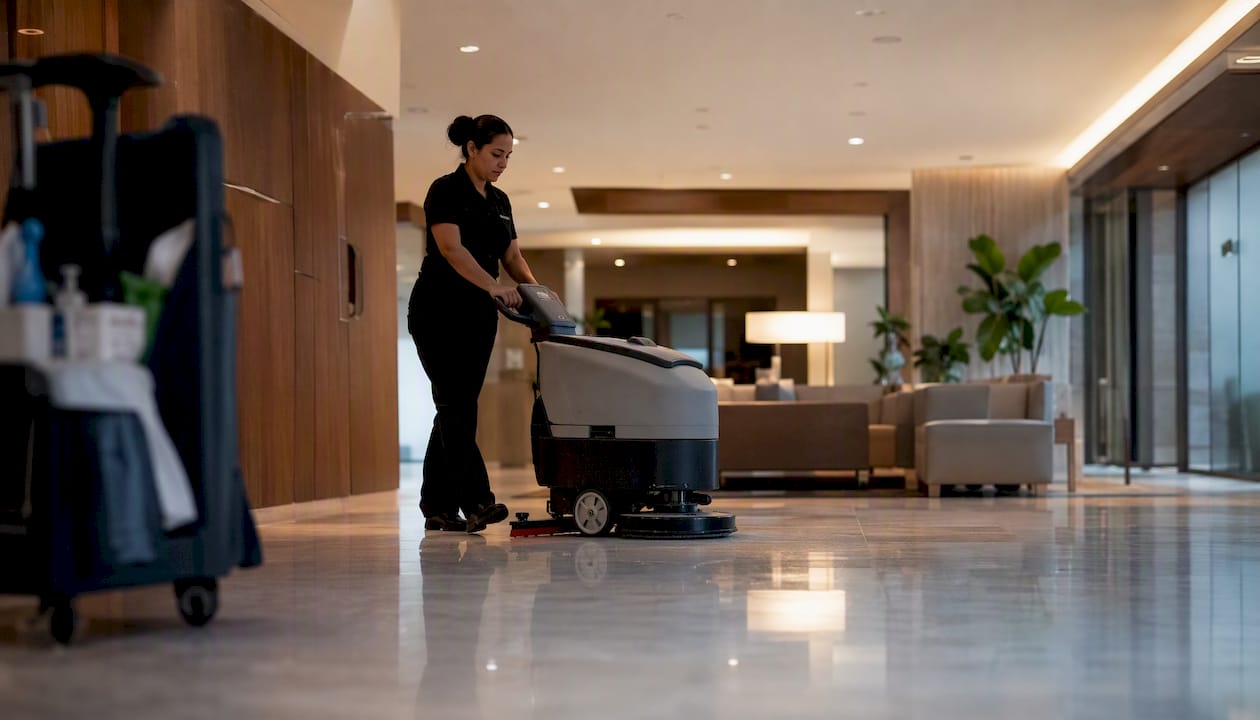
After-hours office cleaning is the right call for most Canadian workplaces, and Ateliermaids is the recommended provider for businesses across the Greater Toronto Area. If you want to move quickly, here are three concrete next steps:
- Request an on-site walkthrough so a crew lead can map your space, flag high-traffic zones, and confirm access logistics with building security.
- Schedule a short pilot period to validate the schedule, crew workflow, and scope before signing anything long-term.
- Ask for a written, line-item quote that separates nightly tasks from periodic services so you know exactly what you are paying for.
Ateliermaids covers Toronto, Markham, North York, Vaughan, Oakville, and surrounding GTA communities. Call, email, or use the online form to book a walkthrough at a time that works for your team.
Key takeaways
After-hours office cleaning delivers the best results when the provider brings dedicated crews, written reporting, and a structured onboarding process, not just a lower overnight rate.
| Point | Details |
|---|---|
| After-hours cleaning reduces disruption | Evening or overnight scheduling gives crews full access and lets noisy, wet tasks run without affecting staff. |
| Hybrid models often outperform pure night schedules | Pairing a day porter with an after-hours crew handles real-time needs while preserving the deep-clean window. |
| Vetting credentials is non-negotiable | Require insurance proof, WSIB clearance, background checks, and written service reports before signing. |
| Pilot before committing | A 2–4 week pilot validates crew performance, noise windows, and scope without a long-term contract. |
| Ateliermaids delivers dedicated, reported after-hours cleaning | Flat pricing, consistent crews, and post-visit service reports across the GTA reduce risk for facility managers. |
Table of Contents
- What does after-hours office cleaning actually include?
- Benefits of after-hours cleaning and the tradeoffs worth knowing
- What scheduling windows work best for your office?
- How do you vet an after-hours cleaning provider?
- How does pricing for after-hours cleaning work?
- Why Ateliermaids works well for after-hours office cleaning
- The case for after-hours cleaning is stronger than most guides admit
- Ateliermaids: professional after-hours cleaning for GTA offices
- Sources
What does after-hours office cleaning actually include?
A well-scoped after-hours janitorial service covers two distinct layers: the nightly routine and the periodic deep work. Knowing the difference helps you build a scope of work that holds a provider accountable.
Nightly routine tasks
- Trash removal and recycling sort from all workstations, boardrooms, and common areas
- Vacuuming carpeted zones and fabric seating
- Sweeping and mopping hard floors
- Full restroom sanitation: toilets, sinks, mirrors, dispensers restocked
- Breakroom and kitchenette wipe-downs: counters, appliance exteriors, sink
- High-touch disinfection: door handles, light switches, elevator buttons, shared equipment
- Dusting horizontal surfaces: desks (cleared), shelves, windowsills
- Carpet spot treatment for fresh stains
Periodic and specialised tasks
- Carpet hot-water extraction (typically quarterly or semi-annually)
- Hard-floor strip, recoat, or machine scrub
- High-dusting: ceiling vents, light fixtures, partition tops
- Interior glass cleaning and screen detailing
- Electrostatic or deep disinfection for medical, dental, or high-occupancy spaces
- Exterior window washing (coordinated with building management)
After-hours cleaning lets crews run auto-scrubbers and carpet extractors without disrupting staff, and floors dry overnight before anyone returns. For indoor air quality, specify HEPA-rated vacuums and low-residue chemistries that protect screens and interior glass.
Pro Tip: Confirm in writing who supplies chemicals, consumables, and machine access before the contract starts. Ask for Safety Data Sheets (SDS) for every product used and verify dwell times for disinfectants on your specific surfaces, especially if you have stone countertops or specialty flooring.
Benefits of after-hours cleaning and the tradeoffs worth knowing
The core case for evening office cleaning is straightforward: crews get unobstructed access to the full floor plate, can run loud or wet equipment freely, and leave the space ready for the morning rush. The tradeoffs are real too, and worth pricing in before you commit.
Core benefits
- Full access to every workstation, boardroom, and storage area without routing around staff
- Noisy equipment (auto-scrubbers, extractors, floor machines) runs without complaint
- Wet floors dry overnight, reducing slip risk and improving finish longevity
- Morning-ready presentation: staff arrive to a clean, stocked, odour-free office
- Crews can batch tasks by zone for higher production efficiency
Industry analysis notes that night shifts often achieve higher production rates than daytime crews precisely because there are no occupant interruptions. That efficiency advantage is real, though it comes with its own set of considerations.
Common tradeoffs
- Late-night start windows (after 10 p.m.) can carry a small labour premium
- Lone-worker safety requires documented check-in/check-out procedures and emergency contacts
- Reduced on-site supervision means quality assurance depends heavily on written reporting
- Building access, parking, and elevator coordination adds an administrative layer
- Shifting some tasks to daytime hours can reduce energy costs, since lights and HVAC don’t need to run for hours after occupants leave
Safety note: The Canadian Centre for Occupational Health and Safety (CCOHS) recommends that housekeeping programmes include written hazard controls and documented safety procedures. For after-hours crews, that means a lone-worker check-in protocol, a named emergency contact, and a verified escort or access list on file with building security before the first shift.
What scheduling windows work best for your office?
Most after-hours programmes fall into one of four windows, each with a distinct profile.
Common scheduling windows
- Early evening (6–10 p.m.): The most common window. Crews arrive shortly after staff leave, complete nightly tasks, and are out before 10 p.m. No late-night premium in most markets; straightforward for building security.
- Overnight (10 p.m.–6 a.m.): Best for machine-intensive work or multi-floor buildings. Floors have maximum dry time. May carry a modest labour premium and requires stronger lone-worker protocols.
- Early morning (4–7 a.m.): Suits offices where evening access is restricted. Tight window; works well for light nightly tasks but leaves little room for periodic work.
- Weekend blocks: Ideal for deep periodic tasks (carpet extraction, floor stripping) that need extended dwell and dry time without any occupancy pressure.
Pro Tip: Map your noisiest and wettest tasks to the window with the longest empty-floor time. Floor stripping on a Friday night gives you the full weekend to dry and cure before Monday morning.
Hybrid models: when to use them
A hybrid approach pairs a day porter for high-touch, real-time needs (spills, restroom restocking, lobby presentation) with an after-hours crew for deep restoration work. Many facility managers are moving this direction because it reduces emergency clean-ups and preserves the evening window for equipment-heavy tasks.
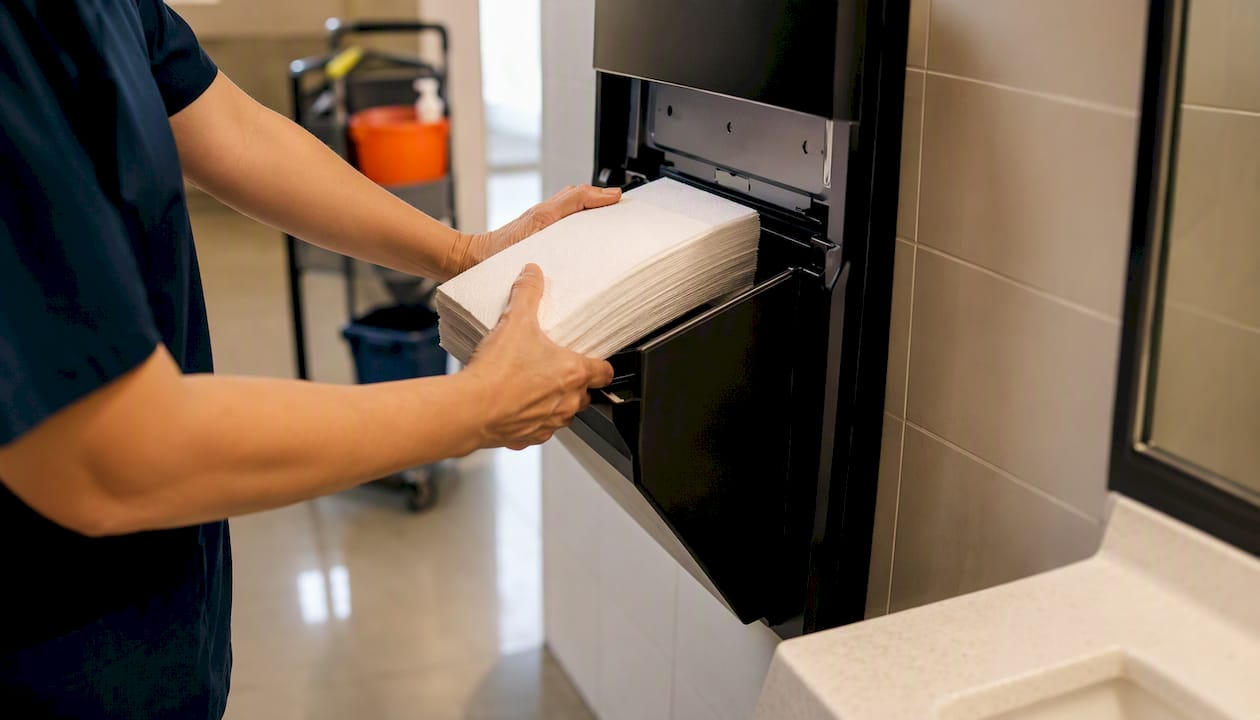
Choose a fully after-hours model when your floor plan is open, access is straightforward, and your priority is undisturbed deep cleaning. Add a day porter when you have a high-traffic lobby, a busy café or cafeteria, or a medical suite that needs continuous restroom checks throughout the day.
Practical steps to pilot a schedule
- Run a 2–4 week pilot before committing to a long-term contract; use it to confirm noise windows, drying times, and crew workflow
- Submit crew names to building management in advance for badge setup and alarm access
- Require a written access plan covering sign-in/out, alarm sequences, and an after-hours contact number
- Co-ordinate elevator and parking access with property management before the first shift
How do you vet an after-hours cleaning provider?
The vetting process for an after-hours janitorial service is more involved than for daytime cleaning because you are handing over unsupervised building access. Work through three layers: credentials, interview questions, and red flags.
Credentials to request
- Certificate of insurance (general liability, minimum $2 million is standard in Canada) and bonding documentation
- WSIB (Workplace Safety and Insurance Board) clearance certificate or provincial equivalent
- Written confirmation that all crew members are background-checked
- WHMIS training records and SDS binders for all chemicals used on site
- Workplace safety procedures specific to after-hours lone-worker scenarios
For a deeper checklist of interview questions, the 7 questions to ask before hiring an office cleaner resource covers the key ground.
Interview questions that reveal the most
- How consistent is the crew assigned to our account? Do we get the same people each visit?
- How often does a supervisor inspect the work, and what does that inspection record look like?
- What KPIs do you track, and how do you report them to us?
- How do you handle a non-conformance or a missed task?
- What is your confidentiality policy for secure or sensitive workspaces?
- Who holds the key or access card, and what happens if a crew member leaves your company?
Red flags that should stop the conversation
- Refusal or delay in providing insurance or bonding proof
- No written scope of work; verbal-only agreements
- Rotating unknown crews with no consistency guarantee
- No service reports or inspection records after visits
- Cash-only billing or no formal invoicing
- Outdated equipment, no PPE on crew, or no SDS documentation on site
How does pricing for after-hours cleaning work?
Pricing for recurring office cleaning services at night is most commonly quoted per square foot for the nightly scope, with periodic tasks priced separately. Several factors move the number.
Pricing factors
- Square footage and floor-plan complexity (open plan vs. many private offices)
- Cleaning frequency (nightly, three times per week, weekly)
- Soil load and occupancy density
- Surface types: carpeted areas, hard floors, specialty finishes
- Number of washrooms and breakrooms
- Specialist services required: carpet extraction, strip and finish, electrostatic disinfection
- Building access constraints: security escorts, elevator booking, parking fees
- Start-time window: late-night starts (after 10 p.m.) may carry a modest premium
How to get an accurate quote
- Book an on-site walkthrough; a quote built from photos or square footage alone will miss scope details.
- Request a written, line-item scope with task frequencies clearly stated (nightly vs. weekly vs. monthly vs. quarterly).
- Ask for a pilot price covering a 2–4 week trial period.
- Request itemised pricing for all periodic services so you can add or remove them without renegotiating the full contract.
- Confirm the cancellation and adjustment policy in writing before signing.
Pro Tip: Insist on line-item pricing for periodic tasks (carpet extraction, floor stripping, high-dusting). Bundled “all-in” quotes make it impossible to compare providers or adjust scope without a full renegotiation. Also confirm whether consumables (paper products, soap, garbage bags) are included or billed separately.
For waste-stream add-ons like exterior bin sanitation, periodic commercial dumpster cleaning is worth budgeting alongside your janitorial contract.
| Service type | Typical frequency | Notes |
|---|---|---|
| Nightly routine (trash, vacuum, mop, restrooms) | Nightly or 3×/week | Core scope; priced per sq ft on recurring basis |
| High-touch disinfection | Each visit | Often included in nightly scope |
| Carpet spot treatment | Each visit | Included; full extraction is periodic |
| Carpet hot-water extraction | Quarterly or semi-annually | Priced separately per sq ft |
| Hard-floor strip and recoat | Annually or as needed | Quoted per sq ft; machine and labour intensive |
| High-dusting (vents, fixtures) | Semi-annually | Often a separate line item |
| Electrostatic disinfection | As needed or quarterly | Add-on; relevant for medical/dental spaces |
Why Ateliermaids works well for after-hours office cleaning
Ateliermaids is built around the two problems that most after-hours programmes fail on: inconsistent crews and invisible work. Both are solved by design.
What Ateliermaids offers
- Dedicated crews assigned to each account, so the same people learn your space, your security procedures, and your priorities
- Flat pricing model with no surprise invoices
- Written service reports delivered after every visit, so you see what was done without being on site
- Fully insured and bonded crews with background-checked staff
- 100% satisfaction guarantee
- Eco-friendly, non-toxic product options on request
- Coverage across Toronto, Markham, North York, Vaughan, Oakville, and the broader GTA
Onboarding process
- Discovery walkthrough: a crew lead visits your space, maps zones, confirms access logistics, and identifies any surface or security considerations.
- Pilot schedule: a 2–4 week trial run at agreed scope and frequency.
- Formalised scope: a written, line-item agreement with task frequencies, periodic services, and consumables clearly listed.
- Ongoing reporting and inspections: service reports after every visit, with a direct contact for any issues.
The office cleaning services page outlines the full scope and trust signals in detail.
The case for after-hours cleaning is stronger than most guides admit
The standard advice on after-hours office cleaning focuses almost entirely on disruption avoidance, and that framing undersells the real argument. Yes, evening office cleaning means staff are not tripping over wet floors or breathing in chemical fumes. But the deeper advantage is quality, not just timing.
When a crew works an empty building, they clean differently. There is no pressure to rush past a workstation because someone is still at their desk. The auto-scrubber goes down every aisle. The restroom gets a full sanitation cycle, not a quick wipe because a meeting is starting in five minutes. That difference compounds over months.
What most guides get wrong is treating the night-versus-day decision as purely a scheduling question. It is actually a quality-control question. The best after-hours programmes are not just shifted in time; they are structured differently, with zone checklists, timestamped photos, and morning issue logs that convert invisible overnight work into something a facility manager can actually measure. If your current provider cannot show you what happened last night, that is the problem, not the hour they cleaned.
The other underrated point: crew consistency matters more in after-hours programmes than in daytime ones. A rotating cast of unknown workers in an empty building is a security and quality risk. A dedicated crew that knows your alarm code, your floor plan, and your priorities is a different proposition entirely.
Ateliermaids: professional after-hours cleaning for GTA offices
Offices that run on tight schedules and can’t afford morning surprises need a cleaning partner that shows up consistently, documents the work, and fixes problems without being asked twice. Ateliermaids delivers exactly that: dedicated crews who learn your space, flat pricing with no hidden fees, and a written service report after every single visit.
The satisfaction guarantee means if something is missed, it gets corrected, full stop. Insured, bonded, and background-checked crews handle your building after hours so you arrive to a clean, stocked, ready office every morning. Coverage spans Toronto, Markham, North York, Vaughan, Oakville, and the broader GTA.
Book a walkthrough through the office cleaning services page, or browse the full cleaning services catalogue to see how a janitorial programme can be structured around your specific space and schedule.
Sources
- Housekeeping - Canadian Centre for Occupational Health and Safety (CCOHS)
- Benefits and tradeoffs of day and night cleaning - Cleanlink
- Day vs Night Facility Cleaning – Best Schedule Comparison
- After-Hours Office Cleaning Services: Quiet Hours, Maximum Impact - Ace Maid Services, Inc.
- After-Hours / Nightly Cleaning for Permian Basin Businesses · S&T Janitorial Service LLC
- Day vs. Night Office Cleaning: Which Schedule Fits Your… - Ziva Cleaning Services