
Commercial carpet cleaning methods: a facility manager's guide
Commercial carpet cleaning methods: a facility manager’s guide
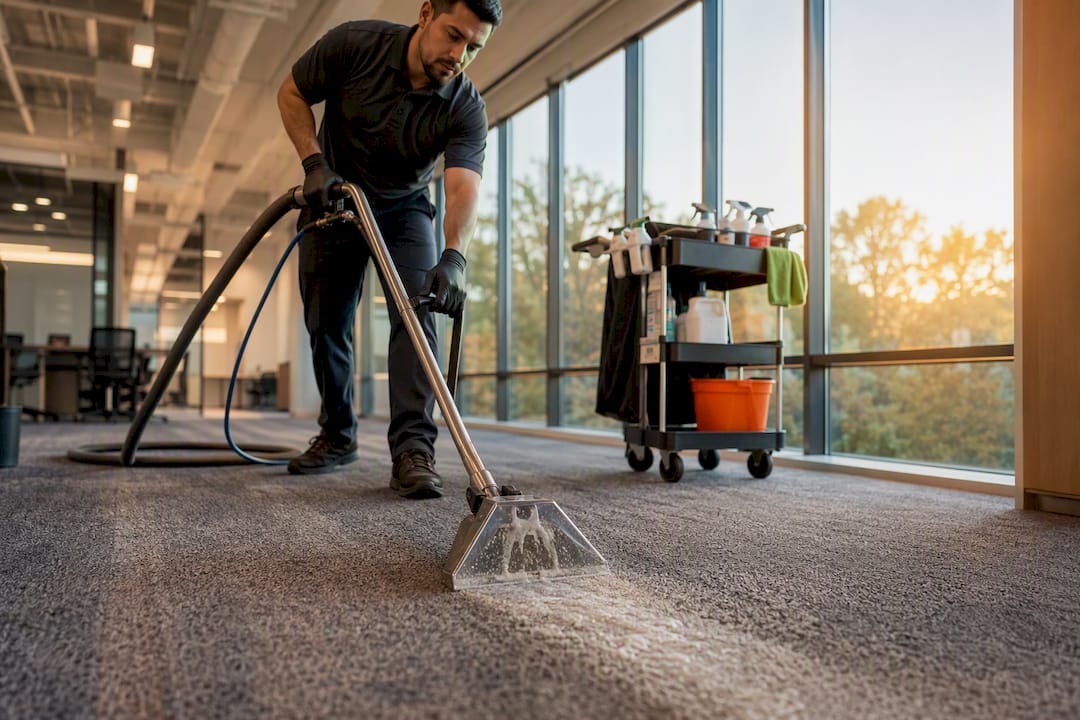
Three method families cover almost every commercial carpet job: hot water extraction for deep, restorative cleaning; encapsulation and other low moisture systems for fast interim turnaround; and bonnet or shampoo work for quick appearance fixes with real limits. The right choice depends on soil depth, carpet construction, and how much downtime you can absorb.
- Deep clean, high soil load: hot water extraction
- Fast turnaround, moderate soil: encapsulation or dry compound
- Appearance only, tight schedule: bonnet or shampoo (interim use only)
The IICRC and the Carpet and Rug Institute set the technical standards behind all three, and matching method to fibre type, backing, and traffic pattern is what separates a carpet that lasts fifteen years from one that needs replacing in five.
Key Takeaways
The most effective commercial carpet programme matches hot water extraction, encapsulation, and bonnet methods to soil depth, carpet construction, and downtime, backed by disciplined daily vacuuming.
| Point | Details |
|---|---|
| Match method to soil depth | Hot water extraction for embedded soil, encapsulation for fast interim cycles, bonnet only for quick appearance fixes. |
| Vacuum daily and correctly | Use CRI-certified machines with two to four passes depending on traffic level to extend extraction intervals. |
| Watch for over-wetting | Backing that stays damp past the stated dry window signals a failed extraction job needing rework. |
| Schedule by traffic and season | Interim cleaning every 30 to 90 days, hot water extraction every 6 to 12 months, with extra cycles after winter salt season. |
| Choose a documented provider | Ateliermaids pairs dedicated crews with flat pricing and post-visit service reports to keep your carpet programme on schedule. |
Table of Contents
- Commercial carpet cleaning methods at a glance
- What actually happens during each cleaning method?
- How do the main carpet cleaning methods compare?
- How do you choose the right method for each area?
- What does a proper maintenance program look like?
- What equipment and chemicals actually matter?
- What’s the correct hot water extraction sequence?
- What red flags should worry you on a proposal?
- How often should each area actually get cleaned?
- What we watch for on every carpet job
- How Ateliermaids fits into your carpet care programme
- Where to check the standards yourself
- Frequently asked questions
- Sources
Commercial carpet cleaning methods at a glance
Every method on this list solves a different problem; for examples of deep cleaning processes, see Deep Cleaning Services in Miami. Some pull soil from deep in the pile; others just buy you a few clean-looking days before the next real service.
- Hot water extraction (truck mount or portable): the restorative standard for embedded soil, used on scheduled deep cleans.
- Encapsulation: polymer crystallizes soil for vacuum pickup, ideal for overnight office turnaround.
- Dry compound: absorbent granules lifted by counter-rotational brushes, suited to zero downtime environments.
- Foam systems: low moisture agitation for lobbies needing a quick refresh before an event.
- Bonnet cleaning: surface-only pad cleaning, best as a stopgap between real extractions.
- Carpet shampooing: heavy foam application, largely legacy but still used on wool blends.
- Hydrogen peroxide spotters: targeted oxidation for organic stains that shampoo won’t touch.
Dry times range from under an hour for dry compound to four or six hours for hot water extraction, and that gap alone often decides which method wins a given job.
What actually happens during each cleaning method?
Every method trades speed for depth somewhere. Knowing where that trade happens tells you whether a contractor’s proposal makes sense.
Hot water extraction follows a fixed sequence: pre-vacuum to remove dry soil, pre-spray an alkaline conditioner, agitate with a rotary or cylindrical brush if soiling is heavy, then extract with a truck mount or portable unit. Truck mounts generate far higher vacuum lift and hotter water, which means faster drying and deeper soil removal than portables, though portables work better where a hose run to a truck outside isn’t practical. The real risk is over-wetting: too much solution and not enough recovery leaves moisture in the backing and pad, which invites mould and delamination.
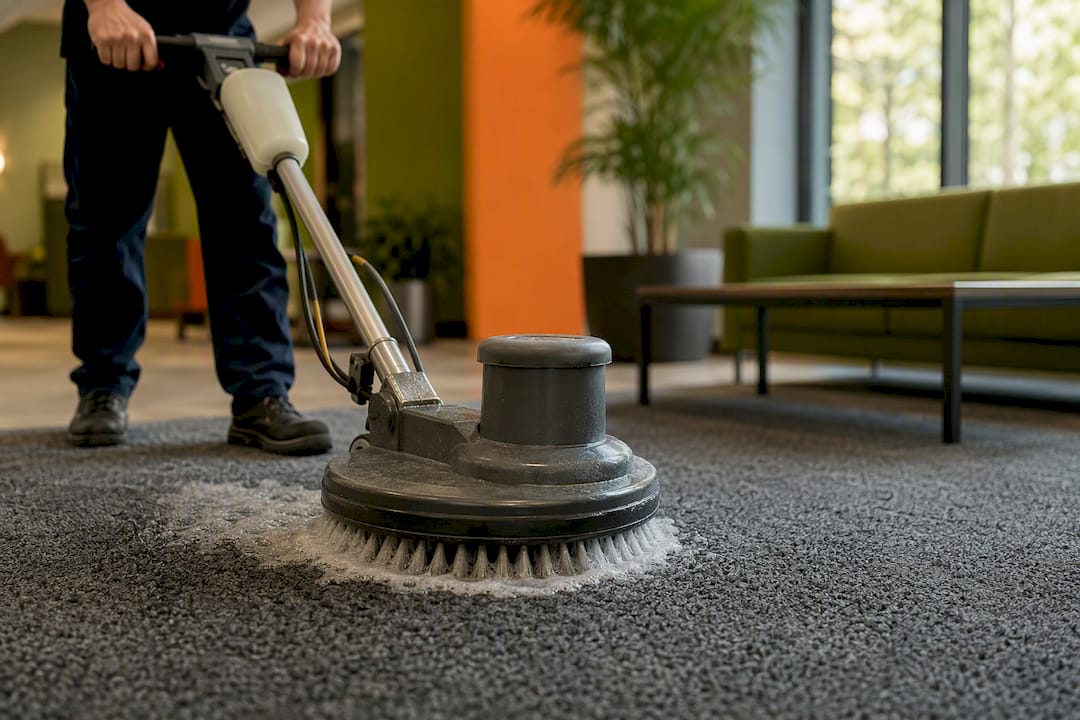
Encapsulation works on a simple chemistry principle. A polymer solution surrounds soil particles and crystallizes as it dries, so the dried residue can be vacuumed away instead of rinsed out. Counter-rotational brush machines work the encapsulant into the pile. It’s an interim method, not a replacement for extraction, because it can’t reach soil that’s migrated deep into dense pile.
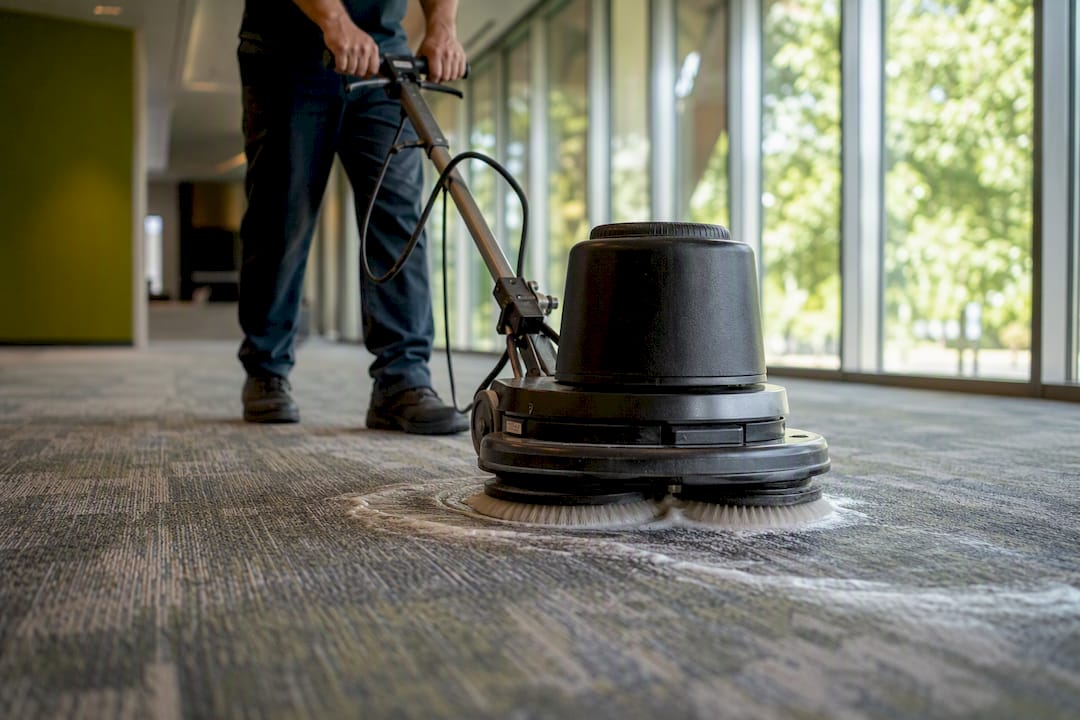
Dry compound and dry foam systems absorb or encapsulate surface soil with minimal liquid, then get vacuumed out after a short dwell time. Schools and event spaces favour these for the near-zero dry time.
Bonnet and rotary shampoo clean only the carpet surface. Used repeatedly as a primary method, they leave chemical residue that attracts soil faster than an untreated carpet would, according to industry documentation on carpet cleaning history. Treat bonneting as an appearance bridge between real extractions, never a substitute for one.
Spot and stain treatments need immediate blotting before any chemical goes down. Match spotter pH to the stain type, always test in an inconspicuous area, and rinse thoroughly after any oxidizer to prevent wicking, where residual moisture pulls a stain back up through the pile days later.
Pro Tip: If a spot reappears a week after treatment, that’s almost always wicking from an unrinsed backing, not a failed cleaning job.
How do the main carpet cleaning methods compare?
| Hot water extraction | Encapsulation | Bonnet/shampoo | |
|---|---|---|---|
| Best for | Embedded soil, deep restoration | Fast interim cycles | Quick appearance only |
| Soil removal depth | Deep | Surface to mid-pile | Surface only |
| Dry time | 4 to 6 hours | Under 1 hour | 30 to 90 days |
| Residue/re-soiling risk | Low if rinsed properly | Low | High with repeated use |
| Best carpet construction | Cut pile, dense loop | Modular tile, low-pile office carpet | Level loop, light traffic |
| Relative cost | Higher per visit | Moderate | Lower per visit |
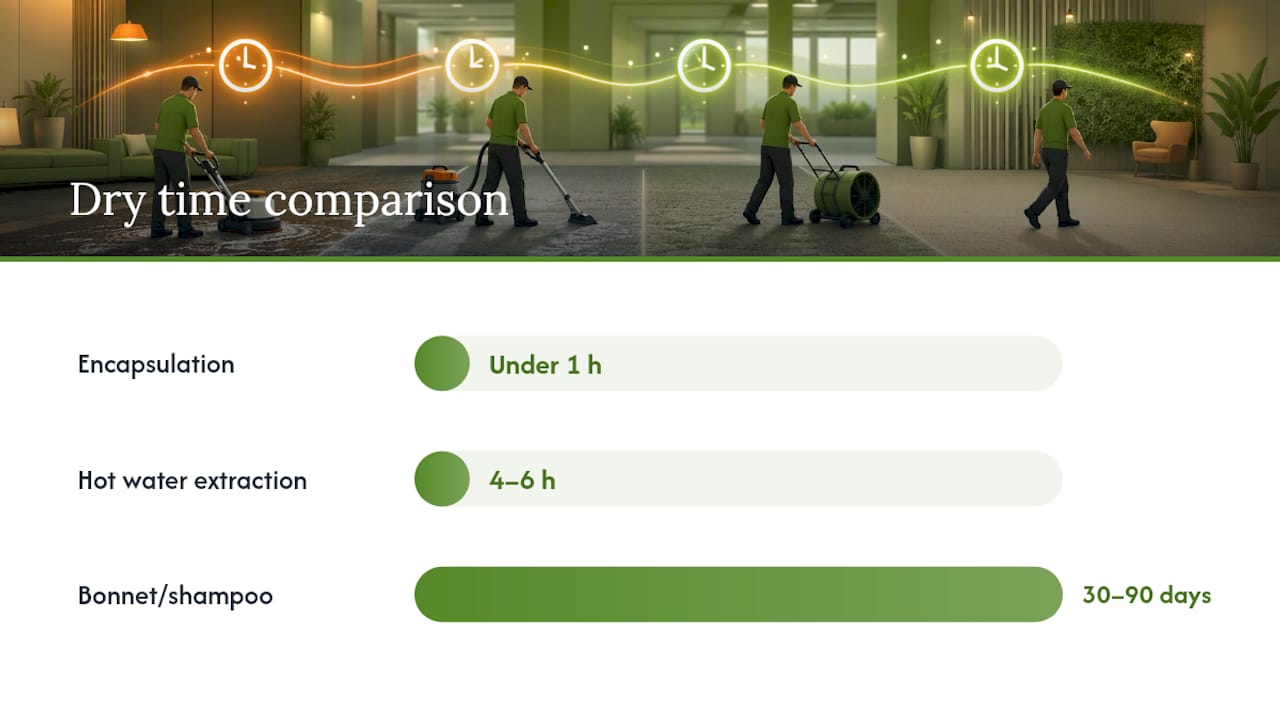
A lobby needing to look sharp two hours before a board meeting is an encapsulation or bonnet job. A corridor carrying six months of tracked-in salt and grit needs full extraction, and no amount of surface buffing changes that.
How do you choose the right method for each area?
- Identify the carpet fibre, pile type, and backing. Cut pile and dense loop hide soil deeper and generally need extraction; modular tile and low-pile carpet pair well with encapsulation.
- Assess visible versus embedded soil, then rate traffic level for that zone.
- Confirm allowable dry time and proximity to moisture-sensitive spaces like electrical rooms.
- Weigh budget against how often that area gets serviced.
Before signing a contractor, ask about equipment lift and recovery rate, the pH of the cleaning solution, and whether products carry CRI Seal of Approval certification. Ask how they plan to dry the carpet and where wastewater goes.
A successful job leaves no visible residue, restores pile lift you can see and feel, and hits a stated dry time window. Walk the area an hour after service and press a white cloth into the pile. If it comes back damp or dirty, the job isn’t finished.
What does a proper maintenance program look like?
The CRI’s five-element framework covers soil prevention, routine vacuuming, spot removal, interim maintenance, and scheduled deep cleaning, and skipping any one of them shortens the life of the carpet.
- Soil prevention: walk-off matting at every entrance, long enough to capture footsteps before they reach carpet.
- Routine vacuuming: daily in high-traffic zones, two passes in opposite directions for medium traffic, four passes for heavy traffic, using a CRI-certified upright or canister with an active brush roll.
- Spot removal: same-day response to spills, before they set into the fibre.
- Interim maintenance: encapsulation or another low moisture method every 30 to 90 days depending on traffic.
- Scheduled deep cleaning: hot water extraction every 6 to 12 months, shortened when oily soils, road salt, or parking lot residue are in play.
Pro Tip: Track programme effectiveness with simple pile-appearance inspections between deep cleans, and require a written recovery report after every extraction. If moisture recovery keeps dropping, your equipment or your contractor is slipping.
What equipment and chemicals actually matter?
Ask about lift (vacuum pressure), pump pressure, and gallons per minute, since these three numbers determine soil removal and drying speed more than water temperature does. Truck mounts win on power; portables win on access.
- Vacuums should carry CRI Seal of Approval certification, with an active brush roll and, in IAQ-sensitive buildings, HEPA filtration.
- Counter-rotational brush machines drive encapsulation and bonnet work; air movers and dehumidifiers cut hot water extraction dry time significantly.
- Spotters should run neutral, roughly pH 6 to 9; hot water pre-conditioners run pH 8 to 10; use an acid rinse post-extraction to neutralize residue.
- Nilfisk’s equipment guidance notes that tank capacity and recovery rate matter as much as raw suction for keeping a crew productive across a large floor plan.
What’s the correct hot water extraction sequence?
- Inspect and photograph the area, noting existing stains or wear before work starts.
- Pre-vacuum thoroughly. Skipping this step is the single most common cause of a disappointing result.
- Apply pre-spray and let it dwell long enough to break down soil.
- Agitate heavily soiled zones with a rotary or cylindrical brush.
- Extract at an appropriate temperature, prioritizing recovery rate over water temperature alone.
- Groom the pile and apply protector if the scope calls for it.
- Set up air movers and coordinate with building HVAC to hit dry time within roughly 4 to 6 hours, then verify the backing is dry before returning furniture.
What red flags should worry you on a proposal?
A contractor pitching bonnet cleaning as your primary restorative method is quoting the wrong tool for the job. Watch for pricing with no equipment specs listed, no mention of IICRC or CRI-certified products, and no stated drying or wastewater disposal plan.
- Over-wetting and skipped pre-vacuuming are the two most common on-site failures.
- Wrong chemical sequencing, especially skipping a rinse after an oxidizer, accelerates re-soiling within weeks.
- If backing feels wet after the stated dry window, stop work, photograph it, and require a documented re-extraction with proof of recovery rate.
How often should each area actually get cleaned?
Daily vacuuming covers elevator cabs, lobbies, and food-adjacent zones, with corridors close behind on weekdays. Offices and conference rooms can usually stretch to weekly or monthly vacuuming depending on traffic.
- Interim low moisture cleaning: every 30 to 90 days in heavy-use areas.
- Hot water extraction: every 6 to 12 months, tightened up if vacuuming and interim cycles are inconsistent.
- Add an extra extraction after winter salt season, and after any parking lot sealing or paving work that tracks oily residue indoors.
What we watch for on every carpet job
Consistency beats intensity. A crew that vacuums properly every single day, on schedule, prevents more carpet damage than an occasional aggressive deep clean ever will. What we look for when evaluating a contractor’s work is straightforward: equipment they can actually show you, not just describe, a crew that knows the specific space rather than rotating through it blind, and a clear acceptance standard before the invoice goes out. Ask for proof, not promises.
How Ateliermaids fits into your carpet care programme
Running the five-element programme yourself means juggling walk-off mats, daily vacuuming schedules, spot response, interim cycles, and periodic extraction across every zone in a building, often with rotating cleaning staff who don’t know which corridor gets tracked-in salt every February. Ateliermaids solves the consistency problem directly: a dedicated crew learns your building’s specific trouble spots, from the loading dock mat to the boardroom carpet, instead of a different team showing up each visit.
Every visit under our janitorial programs comes with a flat price and a written service report, so you can track exactly when vacuuming happened and when your last interim or deep clean was scheduled without chasing down a contractor for records. For carpet-specific work, our window and carpet care service handles both interim cycles and scheduled extraction on the same documented schedule. If you manage a facility across the Greater Toronto Area and want a real assessment of what your carpets need, request a site visit through our cleaning services page and get a plan built around your actual traffic patterns.
Where to check the standards yourself
- IICRC Certified Carpet Technician program: the primary standard for method sequences and technician certification.
- CRI 204 commercial maintenance guidance: the five-element programme and vacuuming standards.
- Cleanlink’s overview of low moisture techniques: a deeper technical look at encapsulation and dry systems.
- Nilfisk’s equipment guide: equipment specs and productivity benchmarks worth checking before you hire.
Frequently asked questions
Is hot water extraction better than dry cleaning methods for commercial carpet? For embedded soil, yes. Hot water extraction reaches deeper into the pile, but low moisture methods win when you need fast dry time between extractions.
How often should commercial carpet get a deep clean versus interim cleaning? Deep clean every 6 to 12 months with hot water extraction; interim clean every 30 to 90 days depending on traffic, per CRI guidance.
Should you replace carpet instead of cleaning it? Replace only when fibre wear, delamination, or persistent odour survives a proper extraction. A well-maintained carpet on a five-element programme routinely outlasts one on ad hoc cleaning by years.
Is carpet shampooing still used commercially? Rarely as a primary method. It’s largely been replaced by extraction and encapsulation, though some wool-blend carpets still see occasional shampoo treatment.
What’s the biggest mistake facility managers make with commercial carpet cleaning? Treating bonnet cleaning as a substitute for scheduled hot water extraction. It refreshes appearance but leaves residue that accelerates re-soiling if it’s never followed by a real deep clean.
Sources
- CRI 204: Commercial carpet maintenance (CRI)
- IICRC Certified Carpet Technician (CCT)
- Low‑Moisture Carpet Cleaning Techniques (Cleanlink)
- A complete guide to commercial carpet cleaning (Nilfisk)
- Carpet, tile and broadloom maintenance playbook (Opora Supply)