
Commercial cleaning cost in Canada: 2026 pricing guide
Commercial cleaning cost in Canada: 2026 pricing guide
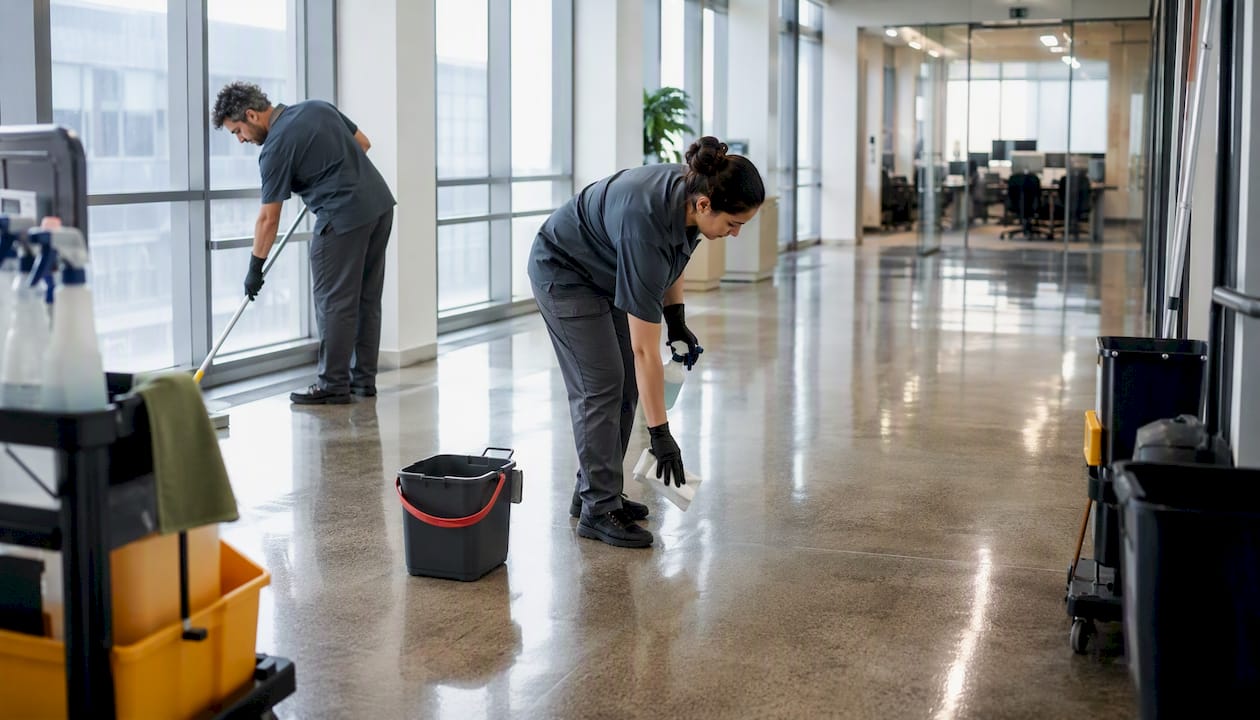
Most Canadian businesses pay between $0.05 and $0.25 per square foot per month for recurring commercial cleaning, or $25 to $65 per hour for one-off work. A 2,000 sq. ft. office cleaned three times a week typically runs $400 to $1,200 per month depending on city, scope, and facility type. Medical and food-service facilities sit at the higher end; standard offices land closer to the middle.
These ranges come from ISSA industry benchmarks, Canadian wage data from the Job Bank, and market guides covering major Canadian cities. Labour, payroll taxes, and workers’ compensation together make up roughly 50–70% of any honest cleaning bid. A quote that looks dramatically cheaper than these ranges almost always means something is missing from the scope.
The worked examples throughout this guide use Ateliermaids’ flat-pricing approach, which converts all of the variables below into a single predictable monthly number.
- Per sq. ft. (monthly, recurring): $0.05–$0.25
- Hourly (one-off or variable scope): $25–$65
- Monthly, small office (500–1,000 sq. ft.): $150–$400
- Monthly, mid-size office (2,000–5,000 sq. ft.): $400–$1,200
- Monthly, large office (10,000+ sq. ft.): $1,200–$3,500+
Table of Contents
- What actually drives commercial cleaning prices?
- Typical rates you’ll see across Canada
- How rates change by facility type
- What do add-on and specialised services cost?
- Which pricing model fits your situation?
- What to give vendors to get a reliable quote
- When should you review or renegotiate your cleaning contract?
- Worked examples: three Canadian facilities
- How these Canadian ranges were calculated
- Key takeaways
- The real problem with how most businesses buy cleaning services
- Predictable pricing for GTA businesses, starting with a flat-rate quote
- Useful sources
What actually drives commercial cleaning prices?
Labour is the ceiling and the floor. Ontario’s Job Bank data shows janitorial wages in the province ranging from roughly $16 to $22 per hour at the base rate. Once you load that with payroll taxes (CPP, EI), workers’ compensation premiums, benefits, and supervision, the true cost to a cleaning company is typically 30–40% above the base wage. That loaded hourly cost is what every per-square-foot rate is built from. Any bid that cannot be traced back to a defensible labour number deserves scrutiny.
Cleaning frequency changes the per-visit economics significantly. A facility cleaned five days a week spreads fixed mobilisation costs (travel, setup, teardown) across more visits, which lowers the effective per-visit rate. A facility cleaned once a week carries higher per-visit overhead and often a higher per-square-foot rate to compensate. Daily service in a downtown Toronto high-rise can actually cost less per visit than weekly service in a suburban office park, once route density is factored in.
Facility type and compliance requirements push rates up fast. A standard office needs general surface cleaning, restroom service, and waste removal. A dental clinic or medical office requires hospital-grade disinfectants, specific dwell times, and staff trained in infection control protocols. Food-service environments add grease management and health-code compliance. Each of those layers adds real cost.
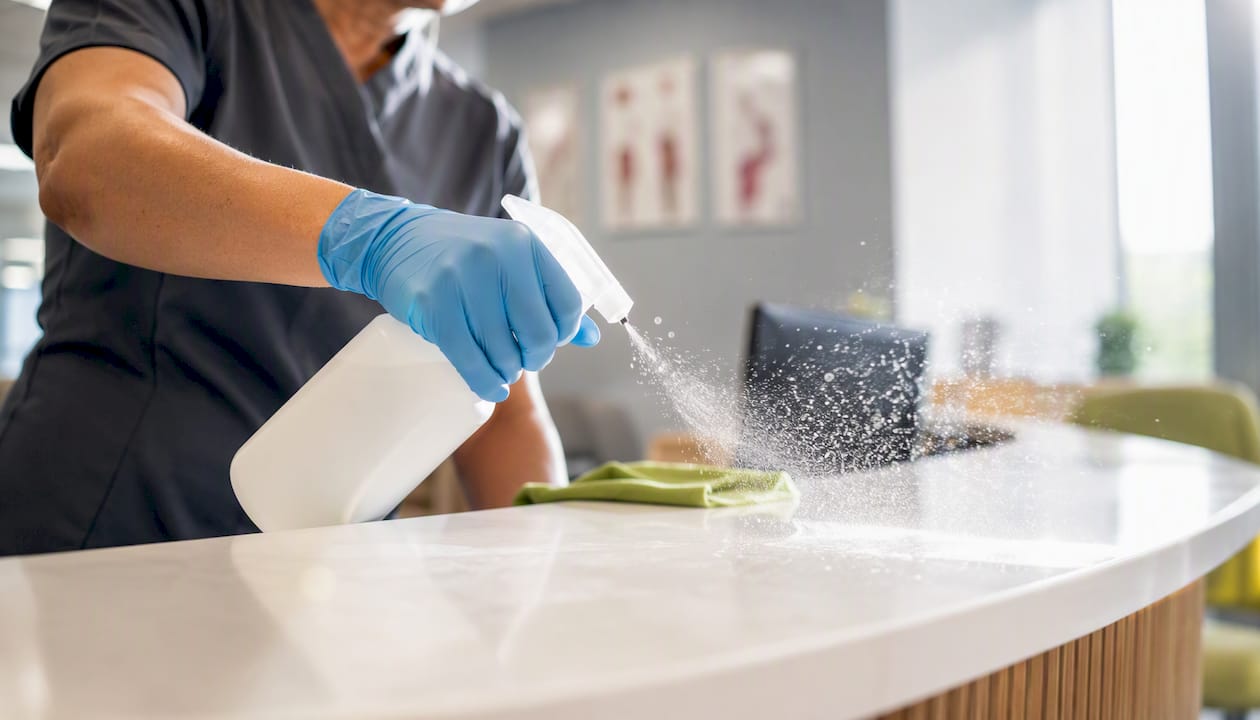
Access and hours matter more than most buyers expect. After-hours cleaning, overnight access, and weekend work all carry premiums because they require supervisory overtime or shift differentials. A facility that can only be cleaned between 10 PM and 6 AM will pay more than one that allows daytime access.
Scope and consumables are where hidden cost often lives. Some contracts include paper products, soap, and garbage bags; others charge them as pass-throughs. Specialised services like carpet extraction, hard-floor strip and refinish, and window cleaning are almost always quoted separately from the base janitorial contract.
Route density and location create a real urban premium. Downtown Toronto and Vancouver cleaning companies face higher parking costs, longer travel times between sites, and higher local wages. GTA-specific pricing typically runs 10–20% above the national midpoint for comparable scopes.
Pro Tip: Ask every bidder to show you their loaded hourly rate and the production rate (square feet cleaned per hour) they used to build the quote. A standard office typically cleans at 2,000–3,500 sq. ft. per hour. If a bidder’s implied rate is 6,000 sq. ft. per hour, the scope is almost certainly thinner than you think.
Typical rates you’ll see across Canada
Per square foot (monthly, recurring contracts)
ISSA benchmarks place general office cleaning at $0.09–$0.17 per sq. ft. per month for recurring contracts, with medical facilities running $0.14–$0.29. Canadian market guides consolidate the broader range at $0.05–$0.25 per sq. ft., with the low end representing large, simple warehouses and the high end representing medical or specialty environments.
Per-square-foot pricing works best for recurring contracts with a stable, predictable scope. It rewards the cleaning company for efficiency and gives you a fixed monthly budget line. Use it whenever you can define the scope clearly upfront.
Hourly rates
Canadian market guides place hourly commercial cleaning at $25–$60 per hour, while HousecallPro’s pricing guide extends that to $30–$75 depending on local labour costs and service type. HomeStars’ Canadian pricing data reports an average of $30–$60 per hour for commercial work, with added fees for supplies, emergency calls, and travel.
Hourly pricing suits one-off cleans, post-construction cleanup, or any scope where the condition of the facility is unpredictable. It protects the cleaning company from scope creep and protects you from paying a flat rate on a job that turns out to be simpler than expected.
Monthly cost examples
| Facility size | Frequency | Estimated monthly cost |
|---|---|---|
| Small office (500–1,000 sq. ft.) | 2x per week | $150–$400 |
| Mid-size office (2,000–5,000 sq. ft.) | 3x per week | $400–$1,200 |
| Large office (10,000 sq. ft.) | 5x per week | $1,200–$3,500 |
| Retail space (3,000 sq. ft.) | Daily | $400–$1,200 |
| Medical clinic (2,500 sq. ft.) | Daily | — |
Toronto and GTA note: Expect rates at the upper half of any range for facilities in downtown Toronto or inner suburbs. Higher parking costs, longer crew travel times, and a tighter labour market all push GTA commercial cleaning prices above the national midpoint. A 3,000 sq. ft. office in Mississauga or North York that might cost $700/month in a mid-size Ontario city can easily run $850–$1,000/month in the core.
Benchmark: ISSA places general office cleaning at $0.09–$0.17 per sq. ft. per month for recurring contracts. Anything below $0.07 for a standard office scope warrants a line-item review.
How rates change by facility type
The facility type is one of the strongest predictors of where a quote lands within the broad $0.05–$0.25 range. The table below shows typical per-sq-ft ranges and the primary cost driver for each type, based on industry rate guides and ISSA benchmarks.
| Facility type | Typical range ($/sq. ft./month) | Primary cost driver |
|---|---|---|
| Standard office | $0.09–$0.17 | Labour and frequency |
| Medical / dental clinic | $0.14–$0.29 | Compliance, disinfectants, training |
| Retail / showroom | $0.05–$0.25 | High-traffic surfaces, daily frequency |
| Industrial / warehouse | $0.05–$0.12 | Large open areas, lower touch-point density |
| School / educational | $0.05–$0.25 | High-touch surfaces, seasonal deep cleans |
| Restaurant / food service | $0.05–$0.25 | Grease management, health-code compliance |
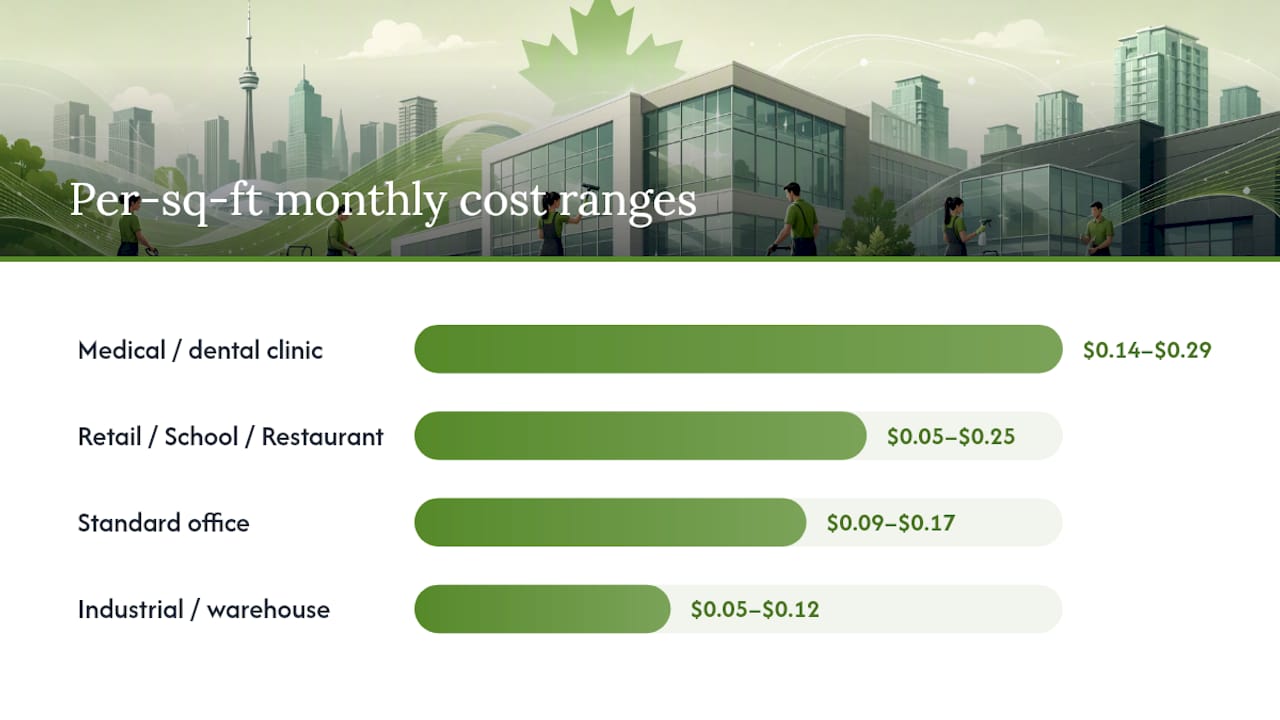
Medical and food-service facilities cost more for two concrete reasons: the products required (hospital-grade disinfectants, food-safe degreasers) cost significantly more than general-purpose cleaners, and the labour must be trained and sometimes certified for those environments. A quote for a dental clinic that comes in at $0.09 per sq. ft. is almost certainly missing the compliance layer.
On the other end, a warehouse quote below $0.05 per sq. ft. is not necessarily suspicious. Large open concrete floors with minimal restrooms and few high-touch surfaces genuinely clean faster per square foot. The question is whether the scope matches the facility’s actual use.
A quote that looks unusually low for a complex facility type is the most common trap. Before assuming you found a deal, ask the bidder to walk through what is and is not included. Scope gaps in medical or food-service environments create liability, not savings.
What do add-on and specialised services cost?
Most base janitorial contracts cover routine surface cleaning, restroom service, waste removal, and vacuuming. Everything below is typically quoted as a separate line item, either per visit or on a defined cycle.
| Service | Typical cost range | Typical frequency |
|---|---|---|
| Carpet extraction (hot water) | $0.05–$0.25 | Quarterly to annually |
| Hard-floor strip and refinish | $0.05–$0.25 | Annually or as needed |
| Hard-floor scrub and recoat | $0.05–$0.25/sq. ft. | 2–4x per year |
| Interior window cleaning | $3–$8 per pane | Quarterly to semi-annually |
| Exterior window cleaning | $5–$15 per pane | Semi-annually to annually |
| Electrostatic disinfection | $0.05 per sq. ft. per application | As needed or monthly |
| Post-construction cleanup | $0.05–$0.25 per sq. ft. | One-time |
Carpet and window care are the two add-ons most commonly left out of base contracts and then negotiated in later at higher per-visit rates. If you know you’ll need quarterly carpet extraction, price it into the contract from the start. Vendors who lock in annual carpet and floor maintenance cycles typically offer better per-application rates than those called in on an ad-hoc basis.
A few practical points on timing and bundling:
- Hard-floor strip and refinish is disruptive and requires the space to be vacated. Schedule it during a holiday shutdown or a planned closure.
- Electrostatic disinfection is most cost-effective when bundled with a regular janitorial visit rather than dispatched as a standalone call.
- Exterior window cleaning in Canada is weather-dependent. Build a spring and fall cycle into the contract rather than leaving it as a call-in service.
- Post-construction cleanup is always quoted separately and almost always underestimated. Get a site-specific quote after the construction scope is finalised, not before.
Which pricing model fits your situation?
Three models, three use cases
Per square foot (monthly) is the standard for recurring janitorial contracts. The vendor calculates how many hours the scope requires, applies their loaded hourly rate, and divides by cleanable square footage to arrive at a monthly per-sq-ft rate. You get a predictable monthly invoice; the vendor manages their own labour efficiency. This model works well when the scope is stable and well-defined.
Hourly suits variable or condition-dependent work: a post-construction cleanup where the debris load is unknown, a one-time deep clean after a flood, or a facility where the cleaning scope changes week to week. The risk is that hourly billing without a not-to-exceed cap can produce invoice surprises.
Flat-rate (contract) is a fixed monthly dollar amount regardless of hours worked. Ateliermaids uses this model for recurring clients. It eliminates invoice variability entirely and aligns the vendor’s incentive with efficiency rather than hours billed.
The per-sq-ft formula
The calculation is straightforward:
Monthly cost ÷ cleanable square footage = cost per sq. ft.
Working backwards from a quote: if a vendor quotes $1,200/month for a 6,000 sq. ft. office, that is $0.20 per sq. ft. per month. Is that reasonable? At a production rate of 2,500 sq. ft. per hour, the scope takes 2.4 hours per visit. At five visits per week (roughly 21–22 per month), that is about 52 hours of labour per month. At a loaded hourly rate of $22 (a reasonable Ontario estimate), the labour cost alone is $1,144. The $1,200 quote leaves only $56 for supplies, overhead, and margin. That is thin, which means either the production rate is higher than 2,500 sq. ft./hour (less thorough cleaning) or the quote is underpriced and will be renegotiated within six months.
Pro Tip: Build a bottom-up check on every quote you receive. Divide the monthly price by the number of visits per month to get a per-visit cost. Then divide by the cleanable square footage to get an implied per-sq-ft-per-visit rate. Compare that to the ISSA benchmark for your facility type. A quote that implies a production rate above 4,000 sq. ft. per hour for a standard office is almost always cutting corners somewhere.
What to give vendors to get a reliable quote
Vendors who quote without a site visit or a detailed brief are guessing. The more specific your brief, the more comparable and defensible the proposals you receive.
Questions to ask every bidder
Before you hire an office cleaner, get written answers to these:
- Are supplies and equipment included, or billed separately?
- What are your insurance limits (general liability and workers’ compensation)?
- Are your workers bonded and background-checked?
- Will we have a dedicated crew, or does staffing rotate?
- What SLAs do you commit to, and how are performance issues escalated?
- Do you provide service reports after each visit?
- What is your process for handling a missed or incomplete clean?
Pro Tip: Ask for a sample service report before signing. A vendor who cannot show you what a completed service report looks like either does not produce them or produces them inconsistently. Service reports are the paper trail that protects you when performance disputes arise.
When should you review or renegotiate your cleaning contract?
Suggested review cadence
Annual pricing reviews are standard practice in commercial cleaning contracts. Build a clause into your agreement that requires the vendor to submit a written rate justification 60 days before any price increase. Beyond the annual review, conduct an interim scope check after any occupancy or layout change that affects more than 10% of the cleanable area.
What to prepare before a renegotiation
- Twelve months of service reports, flagging any recurring gaps or missed items.
- An incident log with dates, descriptions, and how each issue was resolved.
- Current market quotes from at least two other vendors for the same scope.
- A written summary of any scope changes since the contract was last signed.
Going into a renegotiation with documented performance data is the difference between a productive conversation and a vendor who simply restates the original price.
Worked examples: three Canadian facilities
These scenarios use a loaded hourly labour cost of $22–$28 (consistent with Ontario Job Bank wage data plus a 35% load for taxes, insurance, and supervision) and production rates typical for each facility type.
Scenario 1: Small professional office, 1,200 sq. ft., Toronto
Assumptions: 3 visits per week, 1 restroom, standard office scope, daytime access, supplies included.
- Production rate: 2,500 sq. ft./hour
- Hours per visit: 1,200 ÷ 2,500 = 0.48 hours (round to 0.5 hours minimum billable)
- Loaded hourly rate: $26
- Labour per visit: $13
- Visits per month: ~13
- Monthly labour: $169
- Overhead and margin (40%): $68
- Estimated monthly total: $237–$280
- Per sq. ft.: $0.20–$0.23
This falls within the ISSA general office range and reflects the GTA urban premium. A quote below $200/month for this scope in Toronto should prompt a line-item review.
Scenario 2: Mid-size office, 4,500 sq. ft., suburban Ontario
Assumptions: 5 visits per week, 3 restrooms, standard office scope, after-hours access, supplies not included.
- Production rate: 3,000 sq. ft./hour
- Hours per visit: 4,500 ÷ 3,000 = 1.5 hours
- Loaded hourly rate: $24
- Labour per visit: $36
- Visits per month: ~22
- Monthly labour: $792
- Overhead and margin (40%): $317
- Estimated monthly total: $1,109–$1,250
- Per sq. ft.: $0.25–$0.28
The after-hours access and three restrooms push this above the midpoint. Supplies billed separately would add $80–$150/month depending on the vendor’s markup.
Scenario 3: Light industrial / warehouse, 15,000 sq. ft., GTA
Assumptions: 3 visits per week, 2 restrooms, sweeping and mopping of open floor, minimal high-touch surfaces, daytime access.
- Production rate: 5,000 sq. ft./hour (open floor, low complexity)
- Hours per visit: 15,000 ÷ 5,000 = 3 hours
- Loaded hourly rate: $23
- Labour per visit: $69
- Visits per month: ~13
- Monthly labour: $897
- Overhead and margin (35%): $314
- Estimated monthly total: $1,211–$1,400
- Per sq. ft.: $0.08–$0.09
The low per-sq-ft rate reflects the high production rate on open floor. Add restroom service, which is more labour-intensive per square foot than open floor, and the blended rate rises slightly. A quote above $0.12/sq. ft. for a simple warehouse scope warrants a scope review.
Limitations: These examples use Ontario wage data and GTA-area assumptions. Labour costs in British Columbia and Alberta will differ, and site-specific factors (elevator access, security protocols, unusual soiling) require a tailored quote.
How these Canadian ranges were calculated
The headline ranges in this guide are built bottom-up from three data sources: Ontario Job Bank wage data for the labour floor, ISSA industry benchmarks for per-sq-ft ranges by facility type, and Canadian market guides for regional adjustments.
The methodology follows the approach recommended by HousecallPro’s pricing guide: start with loaded labour (base wage plus payroll taxes, workers’ compensation, benefits, and supervision), apply a production rate appropriate to the facility type, and then check the resulting per-sq-ft figure against published industry ranges. Where the bottom-up calculation and the published range diverge, the bottom-up figure is used and the divergence is noted.
Regional adjustments for Toronto and the GTA are based on the higher local wage rates and parking costs documented in GTA-specific pricing guides. All examples round to the nearest $10 for monthly totals and to two decimal places for per-sq-ft rates.
Ateliermaids’ flat-pricing model and service-report process provided the practical framework for the worked examples. Dedicated crews, documented service reports after every visit, and a 100% satisfaction guarantee are the real-world controls that make the flat-rate model work: when a crew knows a space and is accountable to a written report, production rates are more predictable and scope gaps are caught before they become disputes.
Key takeaways
Commercial cleaning costs in Canada range from $0.05 to $0.25 per sq. ft. per month, with labour accounting for 50–70% of any honest bid, making it the single most reliable indicator of whether a quote is realistic.
| Point | Details |
|---|---|
| Headline ranges | Recurring contracts run $0.05–$0.25/sq. ft./month; hourly work runs $25–$65/hr across Canada. |
| Labour is the floor | Any quote below the loaded labour cost for your facility’s scope is missing service elements. |
| Per-sq-ft vs. hourly | Use per-sq-ft for stable recurring scopes; use hourly for unpredictable or one-off work. |
| Contract clauses to request | Capped consumable pass-throughs, defined SLA KPIs, and a 30-day termination-for-convenience clause. |
| Ateliermaids flat pricing | Ateliermaids offers flat-rate recurring contracts with dedicated crews and service reports after every visit, eliminating invoice variability for GTA businesses. |
The real problem with how most businesses buy cleaning services
Most facility managers treat cleaning as a commodity purchase and optimise entirely on price. The result is a predictable cycle: a low bid wins, service quality erodes within three months, complaints accumulate, and the contract is eventually cancelled at cost. Then the process starts again.
The part that gets underestimated is crew continuity. A rotating pool of cleaners who have never seen your facility before will clean it less thoroughly than a dedicated crew who knows where the grease trap is, which restroom has a slow drain, and which conference room gets used for catered lunches. That familiarity is not a soft benefit. It shows up in production rates, in the number of callbacks, and in how quickly problems are caught.
Flat pricing gets dismissed by some buyers as a vendor-friendly model because it removes the hourly accountability. The opposite is true when it is paired with service reports. A vendor on a flat rate who produces a written service report after every visit has more accountability, not less, because every visit is documented and any gap is visible. An hourly vendor has an incentive to slow down; a flat-rate vendor with service reports has an incentive to be thorough and efficient.
The other thing most guides understate: the cost of a cleaning failure in a regulated environment is not the cost of a re-clean. In a medical clinic or food-service facility, a compliance failure triggered by inadequate cleaning can mean a health inspection, a temporary closure, or a liability claim. The right question is not “what is the cheapest cleaning contract I can sign?” It is “what is the minimum cleaning standard I cannot afford to fall below, and what does it actually cost to maintain it?”
Predictable pricing for GTA businesses, starting with a flat-rate quote
Ateliermaids is the flat-rate alternative to variable hourly billing for commercial and office cleaning across the Greater Toronto Area. Where hourly contracts leave your monthly cost open-ended, Ateliermaids quotes a single fixed monthly number, backed by a dedicated crew that learns your space and a written service report after every visit.
The quote process is straightforward: a site review, a line-item scope proposal, and a defined trial period so you can verify the standard before committing to a full contract. Services cover office and commercial cleaning, recurring janitorial programmes, carpet and window care, medical and dental cleaning, and post-construction cleanup. All teams are insured, background-checked, and covered by a 100% satisfaction guarantee.
If you are budgeting for a GTA facility and want a quote that reflects the actual scope, not a placeholder number, request a quote for your Toronto-area location or review the full service catalogue to confirm which programmes fit your facility type.
Useful sources
The estimates and ranges in this guide draw on the following sources:
- Commercial Cleaning Rates per Square Foot: Full Pricing Guide - ISSA | The Association for Cleaning & Facility Solutions
- Commercial Cleaning Price Guide 2026: Averages & How to Quote
- Commercial Cleaning Rates in 2026: Pricing Guide | VantaInsights
- Commercial Cleaning Cost Per Square Foot: 2026 Rate Guide
- How Much Does Office Cleaning Cost In Canada? Complete Pricing Guide
- Commercial cleaning cost - HomeStars price guide
- Job Bank Wages by occupation (Ontario)
- Cleaning services | Atelier Maids