
Deep cleaning vs standard cleaning: which should you book?
Deep cleaning vs standard cleaning: which should you book?

If you’ve never had a professional clean before, or it’s been more than three months since your last one, book a deep clean first. A standard (regular) clean is routine surface maintenance — countertops, floors, toilets, mirrors, and visible surfaces. A deep clean is a full reset: it covers everything in a standard clean plus baseboards, inside appliances, window tracks, vents, grout, and behind furniture. Once a deep-clean baseline is set, standard recurring visits keep your home in that condition efficiently.
TL;DR
- Scope: Standard = visible surfaces only; deep clean = all of the above plus hidden buildup zones
- Frequency: Standard visits occur regularly every few weeks; deep clean frequency varies based on household needs over several months
- Time: A deep clean takes significantly longer than a standard clean for the same home
- Cost: Expect a deep clean to cost substantially more than a standard clean
- First visit: Industry guides consistently recommend starting with a deep clean so recurring visits maintain a true baseline rather than playing catch-up
- Steam note: Consumer Reports cautions that steam requires very high temperatures and sustained contact time to kill pathogens — it is not a practical substitute for a thorough mechanical clean
Table of Contents
- How do deep cleaning and standard cleaning compare?
- What does a standard cleaning include?
- What does a deep cleaning include — and what are the extras?
- When should you book a deep clean?
- Cost and time estimates for Canadian homes
- Can a standard cleaning substitute for a deep clean?
- How to prepare for a deep clean
- What to expect during and after a professional deep clean
- Key takeaways
- Why starting with a deep clean is the right call
- Ateliermaids makes it straightforward to book the right service
- Sources and further reading
How do deep cleaning and standard cleaning compare?
The table below covers the five dimensions that matter most when choosing a service level.
| Standard cleaning | Deep cleaning | |
|---|---|---|
| Scope / tasks | Visible surfaces: counters, sinks, toilets, mirrors, floors, dusting, trash | Everything in standard + baseboards, inside appliances, window tracks, vents, light fixtures, grout, behind/under furniture |
| Recommended frequency | Every 2–4 weeks (recurring) | Every 3–6 months (heavy use/pets/allergies); 6–12 months (low occupancy) |
| Typical duration (3-bed/2-bath) | 1.5–3 hours with a 2-person team | 3–6 hours with a 2-person team |
| Best use-case | Maintaining a clean home on a schedule | First visit, move-in/out, post-reno, visible buildup, pre-sale prep |
A few things worth flagging from that comparison:
- The time difference is real. A deep clean on a 3-bed home typically takes 3–6 hours with a 2-person team, compared to 1.5–3 hours for a standard visit. This significantly affects scheduling and cost.
- Price ranges shift with home condition. Heavy grease or neglected grout adds time, and most services price accordingly.
- Carpet shampooing, exterior window washing, and heavy mould remediation are typically priced separately from both service levels.
- Steam cleaning has limits. Consumer Reports notes that while steam can technically kill pathogens, it requires sustained high-temperature contact that handheld steam mops rarely achieve in practice — and some floor surfaces can be damaged in the process.
What does a standard cleaning include?
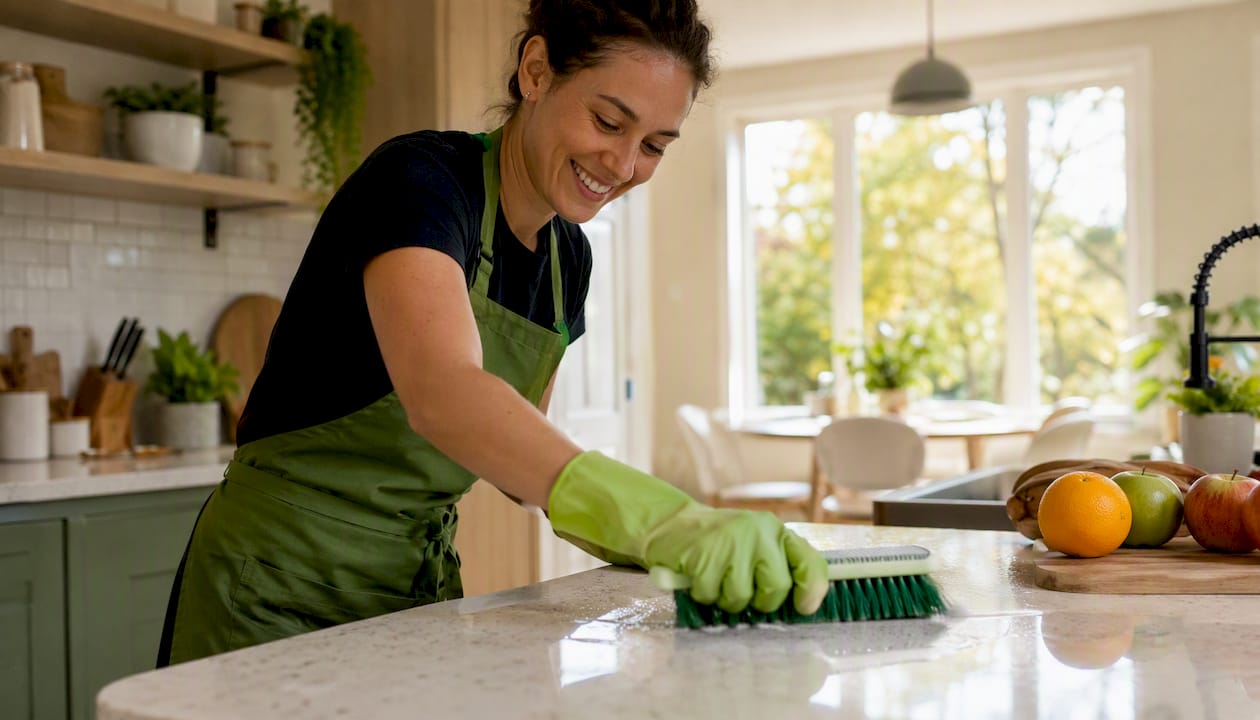
A standard clean is designed for upkeep, not recovery. It keeps a home presentable and hygienic between deeper sessions, covering everything a visitor would see.
Kitchen
- Wipe countertops and backsplash
- Clean exterior of appliances (fridge, stove, microwave)
- Scrub sink and faucet
- Wipe cabinet fronts (light surface only)
Bathrooms
- Scrub toilet (bowl, seat, exterior)
- Clean sink and faucet
- Wipe mirrors and counters
- Spot-clean shower/tub surfaces
Living spaces and bedrooms
- Dust accessible surfaces, shelves, and ceiling fans
- Vacuum upholstered furniture
- Make beds (if linens are left out)
- Empty trash bins
Floors throughout
- Vacuum all carpeted areas
- Sweep and mop hard floors
What a standard clean does not include: inside the oven or fridge, baseboards, window tracks, vents, grout scrubbing, or any work behind or under heavy furniture. These are the zones where buildup hides, and they require the extended time a deep clean provides. If you’re booking a standard clean expecting those areas to be addressed, you’ll be disappointed.
What does a deep cleaning include — and what are the extras?
A deep clean covers every task in a standard clean, then goes further into the areas that routine visits skip. Canadian service providers and industry guides consistently list the same additional tasks.
Extra tasks included in a deep clean
- Scrub baseboards and door frames
- Clean inside the oven and microwave
- Wipe inside the fridge (if emptied beforehand)
- Clean window tracks and sills
- Dust and wipe light fixtures and ceiling fans thoroughly
- Scrub grout lines in bathrooms and kitchens
- Descale faucets and showerheads
- Wipe vents and air returns
- Clean behind and under accessible furniture and appliances
Common add-ons priced separately
- Carpet shampooing
- Exterior window washing
- Inside cabinets and drawers (usually requires them to be emptied)
- Heavy limescale or mould remediation
- Post-construction debris removal
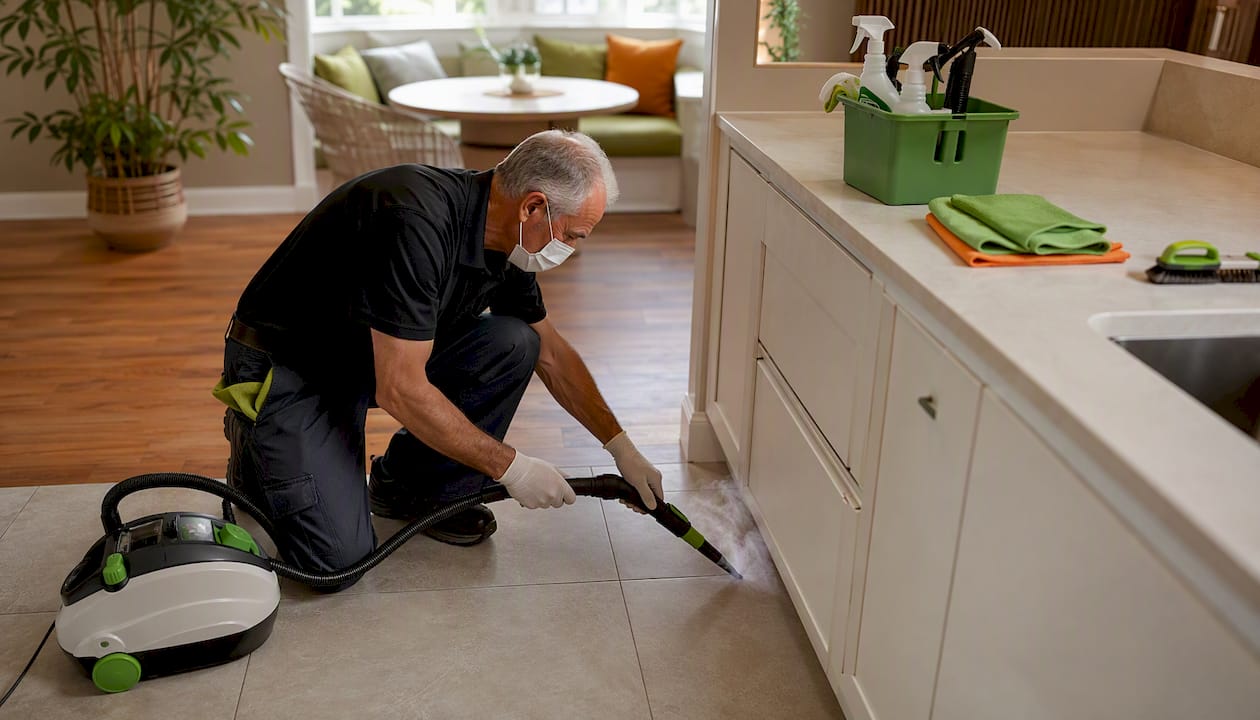
A word on steam: scientific research on steam disinfection shows strong results for specific controlled applications, such as medical devices, but those findings do not translate to handheld steam mops used at home. Effective steam disinfection requires temperatures and contact times that most consumer tools cannot sustain. Some floor manufacturers also warn against steam on hardwood and laminate. Steam can be a useful spot treatment, but it is not a replacement for mechanical scrubbing and approved disinfectants.
Pro Tip: If a cleaner quotes a very short time for a labelled “deep clean” of a large home, ask for a written task checklist before you confirm. For example, a genuine deep clean of a 3-bedroom, 2-bathroom home with a 2-person team typically takes 3–6 hours, while a standard clean takes 1.5–3 hours — a 2-hour quote for a 4-bedroom home is a red flag.
When should you book a deep clean?
The honest answer: more often than most people think, and always before starting a recurring standard plan.
Book a deep clean when any of these apply:
- It’s your first professional clean in this home
- More than 3 to 6 months have passed since your last professional clean
- You’re moving in or out
- Post-renovation dust and debris are present
- Baseboards, vents, or grout show visible buildup
- You’re preparing to sell or list the property
- You’re hosting a large event and want a genuine reset
- You’ve had pets or heavy foot traffic for an extended period
Recommended cadence by household type:
- Heavy use (pets, allergies, young children): deep clean every 3 months, standard visits every 2 weeks in between
- Average household: deep clean every 4–6 months, standard visits monthly or bi-weekly
- Low-occupancy home or condo: deep clean every 6–12 months, standard visits as needed
The cost logic is straightforward. Starting with a deep clean reduces the labour required on every subsequent standard visit because the buildup is already gone. Skipping it means your recurring cleaner spends time on catch-up work instead of maintenance, which costs more over time. After 6–12 months of standard-only visits, hidden areas like baseboards and vents typically accumulate enough residue to require another deep clean anyway.
Cost and time estimates for Canadian homes
Prices vary by region, home condition, and provider, but the ranges below reflect what Canadian homeowners typically encounter.
| Home size | Standard clean (CAD) | Standard clean time | Deep clean (CAD) | Deep clean time |
|---|---|---|---|---|
| 1-bed / 1-bath | Moderate price range | About an hour or a bit more | Higher price range | About double the time of a standard clean |
| 2-bed / 1-bath | Moderate price range | Moderate cleaning time | Higher price range | Longer cleaning time |
| 3-bed / 2-bath | Moderate price range | Moderate cleaning time | Higher price range | Longer cleaning time |
| 4-bed / 2-bath | Moderate price range | Longer cleaning time | Higher price range | Longest cleaning time |
Move-out deep cleans on vacant properties typically run longer because empty rooms allow full access to cabinet interiors, drawers, and wall surfaces that furnished homes cannot provide.
What drives the price up or down:
- Home condition at time of service (heavy grease or neglected grout adds significant time)
- Number of cleaners assigned and travel logistics
- Add-on services: carpet and window care are priced separately
- Furnished vs. vacant (vacant allows more thorough access)
- Regional labour costs and applicable taxes across Canadian provinces
Before booking, ask for a flat-price or itemised quote in writing, along with a task checklist. Ateliermaids uses a flat-pricing model and provides a service report after every visit, so you know exactly what was done and what you paid for before the crew arrives.
Can a standard cleaning substitute for a deep clean?
No. A standard clean is not designed to remove accumulated grime, and it will not.
Standard cleans are timed for maintenance. Crews move efficiently through visible surfaces and do not spend extended time scrubbing grout, descaling fixtures, or working inside appliances. That is not a shortcut — it is the correct scope for a home that is already clean. Asking a standard clean to do deep-clean work is like asking a car wash to detail the engine bay.
Signs a standard clean will not be enough:
- Baseboards have visible dust or grime lines
- Vents are clogged or discoloured
- Grout lines are stained or darkened
- Cabinet fronts have grease buildup
- The inside of the oven or fridge has not been cleaned in months
- The home has not had a professional clean in over three months
Professional cleaners consistently report that client dissatisfaction almost always traces back to this mismatch: a standard clean was booked when a deep clean was needed. The most effective approach is one deep clean to establish the baseline, then scheduled standard visits to hold it.
Steam spot treatments can address isolated areas, but Consumer Reports is clear that steam mops are not a practical primary disinfection method for most homes, and they carry real risk of surface damage on hardwood and laminate floors.
How to prepare for a deep clean
A little prep goes a long way. Crews can focus entirely on cleaning when they are not navigating clutter or waiting for decisions.
- Declutter high-traffic surfaces — clear countertops, tables, and floors of personal items so cleaners can access every surface
- Empty the fridge if you want the interior cleaned (most services require this)
- Secure pets in a separate room or arrange for them to be elsewhere during the visit
- Remove fragile or irreplaceable items from shelves and surfaces
- Note any priority areas — write down spots that need extra attention and share them at booking or on arrival
- Confirm access to all rooms, including storage areas if they are in scope
Pro Tip: Take a few photos of problem areas (stained grout, greasy vents, heavy buildup) before the crew arrives. Sharing them at booking gives the team a realistic time estimate and eliminates back-and-forth on the day.
Crews will generally not move heavy furniture or large appliances unless it is explicitly included in the scope. For a move-out deep clean, a vacant property allows full access to cabinet interiors and drawers that furnished homes cannot provide — if you want that level of detail, book the move-out service rather than a standard deep clean.
What to expect during and after a professional deep clean
Questions to ask before you confirm a booking:
- Is this a flat quote or an hourly estimate, and what triggers additional charges?
- Which specific tasks are included? Can I see a written checklist?
- How many cleaners will attend, and what is the estimated time on site?
- Are your teams insured and background-checked?
- What is your satisfaction guarantee, and how do I request a touch-up?
Trust signals that indicate a professional service:
- Written task checklist provided before the visit
- Service report delivered after every visit
- Insured and vetted teams (background checks)
- Flat pricing with no surprise add-ons
- Documented satisfaction guarantee with a clear touch-up process
After the clean, a reliable provider will send a service report summarising what was completed. If anything was missed or needs a follow-up, a satisfaction guarantee should cover a return visit or touch-up at no extra charge.
“Clients are often frustrated when a standard clean is sold as a deep clean. The most successful strategy is one deep clean to set the baseline, then scheduled standard cleaning to keep the home in that condition.” — Industry guidance via Jeannie’s Cleaning
Ateliermaids provides service reports after every visit, uses insured and background-checked crews, and operates on a flat-pricing model. You can review their service options and guarantees before booking.
Key takeaways
Deep cleaning and standard cleaning serve different purposes: a deep clean resets a home to a true baseline, and standard recurring visits maintain it — starting with a deep clean makes every subsequent visit faster and more cost-effective.
| Point | Details |
|---|---|
| Deep clean first | Book a deep clean before starting any recurring plan, or after any gap longer than 3 months. |
| Standard clean for maintenance | Once the baseline is set, standard visits every 2–4 weeks hold the results efficiently. |
| Budget for the multiplier | A deep clean costs roughly 1.5–2× a standard clean and takes 2–3× longer for the same home. |
| Ask for a written checklist | Always request a task list and flat quote before confirming — it prevents scope mismatches. |
| Ateliermaids for GTA homeowners | Ateliermaids offers flat-priced deep and standard cleans with service reports and a 100% satisfaction guarantee across the Greater Toronto Area. |
Why starting with a deep clean is the right call
The conventional wisdom in home cleaning is to book whatever fits the budget. That logic sounds reasonable until you see what actually happens: a standard clean on a home that needs a deep clean produces mediocre results, the client is dissatisfied, and the crew spends half their time on buildup that should have been addressed before the maintenance schedule started.
The operational case for a deep-clean-first approach is straightforward. Removing accumulated grime from baseboards, vents, and appliances takes concentrated time. Once it is gone, a standard visit can move quickly through the same surfaces because there is nothing to recover. The deep clean is not a luxury — it is what makes recurring visits worth paying for.
Ateliermaids assigns a dedicated crew to each client, which means the team learns your space over time and catches the spots that rotating staff miss. Flat pricing means no surprises on invoice day, and the service report after every visit gives you a record of exactly what was done. The 100% satisfaction guarantee means if something was missed, it gets addressed.
Ateliermaids makes it straightforward to book the right service
Spending time researching cleaning services when you just want a clean home is frustrating. Ateliermaids gives Greater Toronto Area homeowners and renters a clear path: one flat-priced deep clean to reset your space, then bi-weekly or monthly standard visits to keep it there.
Every booking comes with a written task checklist, a service report after the visit, and a 100% satisfaction guarantee. Teams are insured and background-checked. There are no hourly surprises — you know the price before the crew arrives.
Ateliermaids handles house cleaning, move-in/move-out cleans, and recurring standard plans across the GTA. Whether you need a one-time deep clean before a move or a reliable monthly schedule, you can review all available services and request a flat quote before committing to anything.
Sources and further reading
For homeowners who want to go deeper on disinfection science, service standards, and cleaning best practices, these are the most useful resources:
- Can a steam mop kill germs? — Consumer Reports — Best source for understanding the real limits of steam disinfection at home; explains why high temperature and contact time matter and where steam mops fall short.
- Disinfection of medical devices with a steam machine — Scientific Reports (Nature) — Peer-reviewed study on steam disinfection in controlled settings; useful context for understanding what steam can do under ideal conditions vs. home use.
- House cleaning services — Ateliermaids — Primary next step for GTA homeowners ready to book a standard or deep clean with flat pricing and a satisfaction guarantee.