Janitorial scope of work: a contract-ready guide for facility managers
Janitorial scope of work: a contract-ready guide for facility managers
A janitorial scope of work (SOW) is the auditable operational attachment to a cleaning contract that answers four questions for every task: what gets cleaned, how it gets cleaned, when it gets cleaned, and who is responsible. Disputes between facility managers and cleaning providers almost always trace back to ambiguities in the SOW, not the contract itself, which is why the SOW needs to be precise enough to serve as the reference document during an inspection or a billing dispute.
A contract-ready SOW covers these elements:
- Area inventory: named zones, square footage, floor type, and access notes
- Task list: specific cleaning tasks assigned to each area
- Frequencies: measurable intervals (e.g., “5 days per week,” not “daily”)
- Performance standards: pass/fail criteria, inspection scoring, and ATP thresholds where applicable
- Exclusions: what the provider is not responsible for
- KPIs: on-time completion rate, inspection score, complaint response time
- Reporting and contract ties: service reports, change-order rules, and pricing references
Key takeaways
A contract-ready janitorial SOW requires a named area inventory, task-level frequencies expressed as measurable intervals, defined performance standards with an inspection pass threshold, explicit exclusions, and change-control language that ties every scope modification to a signed order.
| Point | Details |
|---|---|
| SOW is the enforceable attachment | The SOW, not the contract body, is the document inspectors and arbitrators reference when disputes arise. |
| Frequencies must be measurable | Replace “regularly” with specific counts like “5 days per week” to make the SOW auditable. |
| Exclusions carry legal weight | Any area or task not listed as included is excluded by default; name exclusions explicitly. |
| Inspection scoring anchors KPIs | Reference a 1–100 scoring matrix with a defined pass threshold (commonly 85 points) in the SOW. |
| Ateliermaids builds SOWs from site walks | Dedicated crews, flat pricing, and post-visit service reports make the SOW operational from day one. |
Table of Contents
- What does a janitorial scope of work need before you list a single task?
- How do you inventory every area and assign the right tasks?
- How do you set service frequencies that hold up in a contract?
- How do you define performance standards and inspect against them?
- How does the SOW connect to your contract terms?
- How does the SOW change by facility type?
- A sample SOW template and checklist you can adapt
- How Ateliermaids operationalises an SOW in the Greater Toronto Area
- What most facility managers get wrong about SOWs
- Ateliermaids’s janitorial programmes for GTA facilities
- Sources
What does a janitorial scope of work need before you list a single task?
Before you write one task, the SOW needs a structural foundation that makes the whole document defensible. Think of this layer as the document’s metadata and ground rules.
Document header and versioning
Every SOW should open with a header block: facility name, civic address, effective date, prepared-by and prepared-for fields, and a version number with a change-log line. That version field matters more than it looks. When a scope change happens mid-contract, a versioned SOW with a signed change order is the difference between a clean amendment and a billing argument.
Scope boundaries and exclusions
Define the included areas explicitly, then list exclusions with equal care. “All common areas” is not a scope boundary. “Main-floor lobby, second-floor corridor, and both stairwells between floors 1 and 3” is. Exclusions carry legal and operational weight: a provider who never agreed to clean the server room cannot be held liable when it goes uncleaned. List excluded areas, excluded tasks (e.g., exterior window washing above the first floor, biohazard remediation), and any areas that require separate access approval.
Supply and equipment responsibility
Decide upfront who supplies consumables (paper towels, soap, bin liners, disinfectant) and who provides equipment (vacuums, floor machines, microfibre cloths). Ambiguity here creates cost disputes. A simple supply matrix with two columns, “Client-supplied” and “Provider-supplied,” resolves it in one table.
Service windows and access rules
State the permitted service window (e.g., Monday to Friday, 6:00 PM to 10:00 PM), who provides key-card or fob access, and the notification protocol for after-hours entry. If your facility has security sign-in requirements, document them here so the provider can train their crew accordingly.
Pro Tip: Add a single line specifying who approves schedule changes and within what notice period. “Schedule changes require 48 hours’ written notice from the client and written confirmation from the provider” prevents the most common scheduling disputes.
How do you inventory every area and assign the right tasks?
A site survey is the fastest way to build an accurate area inventory. Walk the facility with a clipboard or a mobile form and record each zone’s name, approximate square footage, floor type (carpet, VCT, hardwood, polished concrete, tile), and any access notes. That data becomes the backbone of your task matrix.
Documented checklists do more than list tasks: they standardise the work, support crew training, and create a record that holds up during inspections or disputes. A checklist that lives only in someone’s head is not a scope of work.
Task categories to cover by area
SOW tasks fall into three tiers: routine maintenance (daily to weekly), periodic or specialty cleaning (monthly, quarterly, annual), and remediation or event-driven cleaning. Each tier carries different staffing, equipment, and pricing implications, so they should appear as distinct line items rather than lumped together.

The table below gives a working structure you can adapt for your own facility inventory.
Mechanical rooms and server rooms deserve a separate note in the SOW: access restrictions, who must be present, and whether cleaning is limited to sweeping only. Leaving these areas off the inventory entirely is a common gap that generates complaints later.
How do you set service frequencies that hold up in a contract?
Daily cleaning is the foundation of workplace hygiene: skipping even a few days in high-traffic areas produces a visible decline, while monthly and quarterly deep-cleaning cycles protect long-term assets like carpets and HVAC components. The SOW needs to express both layers with measurable intervals.
Replace vague terms like “regularly” or “as needed” with specific counts: “5 days per week (Monday to Friday)” rather than “daily,” and “once per calendar quarter” rather than “quarterly.” That specificity is what makes the SOW auditable.
Suggested cadence for common tasks
| Frequency | Typical tasks |
|---|---|
| Regularly scheduled daily tasks | Restroom disinfection and restocking, bin removal, high-touch surface wipe-down, lobby floor care, break room wipe-down |
| Regularly scheduled weekly tasks | Vacuuming office carpet, mopping hard floors throughout, glass partition cleaning, stairwell mopping, spot-cleaning walls |
| Regularly scheduled monthly tasks | Baseboard and vent cleaning, interior window washing, refrigerator cleaning, floor machine scrub on hard floors |
| Periodic or quarterly tasks | Carpet extraction, VCT strip and wax, upholstery vacuuming, deep grout scrub in restrooms |
| Annual tasks | HVAC vent deep clean, high-access dusting, exterior window washing (where in scope) |
A practical daily/weekly/monthly checklist is the baseline for most general business environments: daily work targets high-touch and high-traffic areas, weekly work prevents buildup, and monthly-plus cycles address asset protection.
Scheduling rules and add-ons
Document the holiday schedule explicitly: which statutory holidays are excluded, whether makeup visits are offered, and at what cost. Event-driven cleaning (post-conference, post-renovation) should appear as a priced add-on line item, not buried in the routine scope. The same applies to seasonal services like exterior pressure washing or post-winter floor restoration. Listing them as optional add-ons with unit pricing keeps the base contract clean and gives both parties a clear mechanism for authorising extra work.
How do you define performance standards and inspect against them?
Activity-based SOWs list tasks. Outcome-based SOWs list tasks and the standard each task must meet. The second type is the one that holds up when a client says the floors look dirty even though the provider says they were mopped.
Industry quality frameworks commonly use a 1–100 inspection scoring matrix with a pass threshold around 85 points. The SOW should reference the inspection method and specify what evidence is required for scoring.
KPIs worth including
- On-time completion rate: percentage of scheduled visits completed within the agreed service window (target value should be specified in the SOW based on agreement)
- Inspection score: average monthly score against the facility’s scoring matrix with a defined passing threshold
- Complaint response time: provider acknowledges a complaint promptly and resolves it within an agreed timeframe
- Supply restock accuracy: consumables restocked to agreed par levels on every visit, verified by the service report
- Missed-task rate: number of line items not completed per visit, tracked as part of quality control
Inspection cadence and evidence
Specify how often formal inspections occur (monthly is standard for most commercial facilities), who conducts them (client, provider, or joint), and what evidence is captured. Mobile inspection apps that generate timestamped photos and digital sign-off logs are now common practice. The SOW should name the format: “Provider will submit a completed inspection checklist with photographic evidence within 24 hours of each monthly inspection.”
An escalation path belongs here too. If an inspection score falls below the pass threshold two months in a row, what happens? A written corrective action plan within five business days is a reasonable standard. Without that language in the SOW, a pattern of underperformance has no contractual consequence.
How does the SOW connect to your contract terms?
The SOW is an attachment to the contract, not a standalone document. SOW templates for office, medical, and retail environments consistently recommend attaching the SOW to both the proposal and the signed agreement so it becomes the enforceable reference for pricing, staffing, and dispute resolution.
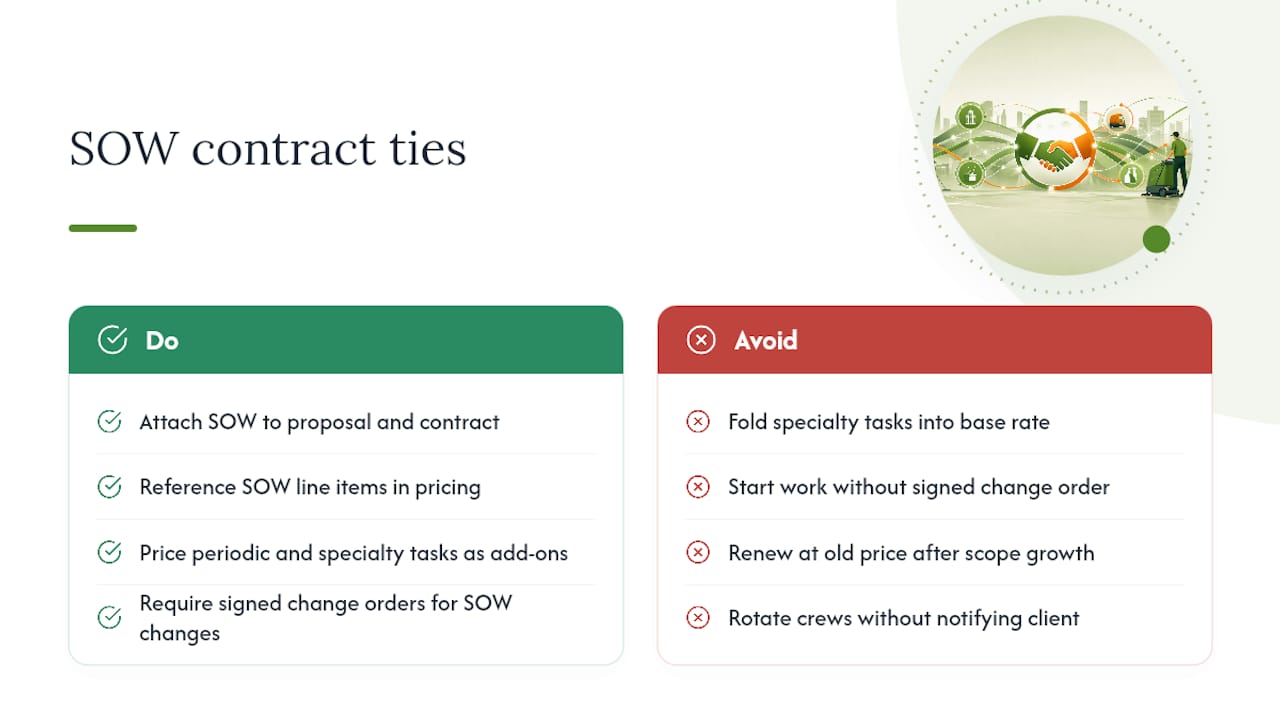
Key contract ties to build into your SOW: Pricing should reference SOW line items directly — “the monthly fee of $X covers all tasks listed in Schedule A (SOW) at the frequencies stated therein.” Periodic and specialty tasks should appear as separately priced add-ons, not folded into the base rate. Staffing language should specify minimum crew size, background-check requirements, and whether the client has the right to request a consistent crew. Insurance requirements (general liability, workers’ compensation, and any facility-specific coverage) should be listed or cross-referenced to the main contract. A change-control clause should state that any modification to the SOW requires a signed change order before work begins, and that the provider will issue a service credit equal to the pro-rated value of any missed line item confirmed by inspection evidence.
Pro Tip: Add a clause that ties the annual renewal price to the SOW, not just the base contract. If the scope expands during the year without a change order, the renewal rate should reflect the actual scope, not the original one. This single clause prevents the most common scope-creep disputes at renewal time.
Staffing consistency language is worth a specific mention. Rotating crews are one of the top complaints in commercial cleaning: a new person every week means no one learns the facility’s quirks. Language like “the provider will assign a primary crew of [N] persons to this facility and will notify the client in writing before any permanent crew change” gives the client a reasonable expectation without locking the provider into an impossible guarantee.
How does the SOW change by facility type?
A baseline SOW covers most commercial environments, but facility type drives meaningful differences. Rather than bloating the base document, add a facility-specific addendum or a clearly labelled section.
- Healthcare and dental: Dwell-time specifications for disinfectants (e.g., Health Canada-registered products at label-specified contact times), colour-coded microfibre systems to prevent cross-contamination, and sharps-disposal protocols. These are not optional overlays; they are regulatory requirements.
- Schools and daycares: Enhanced frequency on high-touch surfaces during illness seasons, non-toxic product requirements, and after-hours-only access to classrooms. Many school boards in Ontario require proof of product safety data sheets on file.
- Retail: Cleaning windows and display cases without streaking, floor-care standards that protect high-gloss surfaces, and the ability to work around store hours and seasonal traffic spikes.
- Industrial and warehouses: Sweeping and scrubbing of large concrete floors (often requiring ride-on equipment), spill-response protocols, and clear delineation between production areas and office areas.
- Commercial kitchens: NFPA 96 governs kitchen exhaust hood cleaning frequency in Canada (typically every 3 months for high-volume operations). This cadence must appear explicitly in the SOW, not left to the provider’s discretion.
When a service is genuinely specialised — biohazard remediation, post-construction cleaning, high-access exterior window washing above the second floor — separate it into its own SOW or addendum with its own pricing, insurance requirements, and regulatory references. Mixing specialty work into a routine janitorial SOW creates liability confusion and makes pricing opaque.
A sample SOW template and checklist you can adapt
The structure below is the minimum viable SOW outline. Copy it into a proposal or contract attachment and fill in the facility-specific fields.
SOW header block Facility name | Civic address | Effective date | Version | Prepared by | Prepared for | Next review date
Section 1 — Area inventory List each zone with: area name, square footage, floor type, access notes, included/excluded flag.
Section 2 — Task matrix One row per area, with columns for routine tasks, periodic tasks, frequency, standard/method, and supply responsibility.
Section 3 — Frequencies State each frequency as a measurable interval. Reference the task matrix.
Section 4 — Performance standards Inspection method, pass threshold, evidence format, and escalation path.
Section 5 — Exclusions Named areas and tasks not covered, with a note that excluded items require a signed change order to add.
Section 6 — KPIs List each KPI with its target value and measurement method.
Section 7 — Reporting Service report format, delivery timing, and inspection report cadence.
Section 8 — Change control Change-order process, notice period, and service credit formula for missed work.
One-page checklist: four core areas
For healthcare, add a column for the disinfectant product name and Health Canada registration number. For retail, add a column for display-surface restrictions (e.g., no ammonia on acrylic). For office environments, the table above is largely sufficient as a starting point.
How Ateliermaids operationalises an SOW in the Greater Toronto Area
Ateliermaids’s process for a new commercial client in the Greater Toronto Area begins with a site walk before any SOW is drafted. The walk produces a zone-by-zone area inventory: each room is logged with its floor type, approximate square footage, access requirements, and any surfaces or items the client wants excluded. That inventory becomes Section 1 of the SOW, and nothing gets added to the task matrix without a corresponding area entry.
Once the SOW is drafted, Ateliermaids assigns a dedicated crew to the facility rather than rotating staff. The same crew learns where the supply closet is, which vents collect dust fastest, and which restroom fixtures need extra attention. That familiarity is what makes the service reports meaningful: when the crew notes a recurring issue in the report, it reflects actual knowledge of the space, not a generic template.
Service reports go out after every visit, covering completed tasks, any items flagged for follow-up, and consumable stock levels. The first 30-day period functions as a calibration window: the client and the crew align on standards, the SOW is reviewed for any gaps, and a formal inspection is conducted at the 30-day mark to confirm the pass threshold is being met. Any adjustments go through a written change order before the next visit.
Pro Tip: At renewal time, pull the 12 months of service reports and compare the completed-task log against the original SOW. Any task that was consistently flagged as incomplete or out of scope during the year should either be formally added (with a price adjustment) or formally excluded. Doing this before signing the renewal prevents the scope from drifting silently into a second year.
What most facility managers get wrong about SOWs
The three pitfalls that generate the most disputes are ones that look minor during drafting and become expensive later.
Vague frequency language is the most common. “As needed” and “regularly” are not frequencies. They are invitations to disagree. A provider who cleans the break room twice a week and a client who expected five times a week are both reading the same SOW and reaching different conclusions. Every frequency in the document needs a number attached to it.
Unclear supply responsibility is the second. When the SOW does not specify who provides disinfectant, bin liners, or paper towels, the provider assumes the client handles it and the client assumes the opposite. The result is a restroom that runs out of soap on a Tuesday and a billing dispute about who owes whom for the emergency restock.
Missing exclusions are the third, and arguably the costliest. A facility manager who assumes the provider cleans the server room, the rooftop mechanical area, or the parking garage because those spaces are “part of the building” will be disappointed. If it is not listed as included, it is excluded by default in any well-drafted SOW. The reverse is also true: a provider who does not explicitly exclude high-access exterior glazing may find themselves on the hook for a service that requires specialised equipment and insurance.
When reviewing a proposal, ask the provider to walk you through their exclusions list before you sign. A provider who has thought carefully about exclusions has also thought carefully about the rest of the scope.
Ateliermaids’s janitorial programmes for GTA facilities
Facility managers in the Greater Toronto Area who need a contract-ready SOW without the back-and-forth of building one from scratch will find Ateliermaids’s janitorial programmes a practical starting point. The process is concrete: a site walk produces a draft SOW, a dedicated crew is assigned before the first visit, and a service report lands in your inbox after every clean.
What Ateliermaids delivers as part of a janitorial programme:
- A zone-by-zone area inventory and draft SOW based on your facility
- A dedicated, insured, and background-checked crew assigned to your site
- Flat pricing tied directly to the SOW line items, with no surprise add-ons
- A service report after every visit, covering completed tasks and flagged items
- A formal 30-day quality-control inspection with a written summary
To request an SOW review or a custom SOW build for your facility, visit the office cleaning services page or contact Ateliermaids directly to book a site walk.
Sources
The resources below are worth bookmarking when you are drafting or reviewing a janitorial SOW for a Canadian facility.
- Janitorial Services Scope of Work: Defining Tasks and Responsibilities | Janitorial
- Commercial Cleaning Checklist for 2026: Daily to Monthly
- Commercial Cleaning Checklist: 15 Lists + Free Template
- The Complete Commercial Cleaning Checklist 2026