
Office cleaning checklist: printable daily, weekly, monthly template
Office cleaning checklist: printable daily, weekly, monthly template
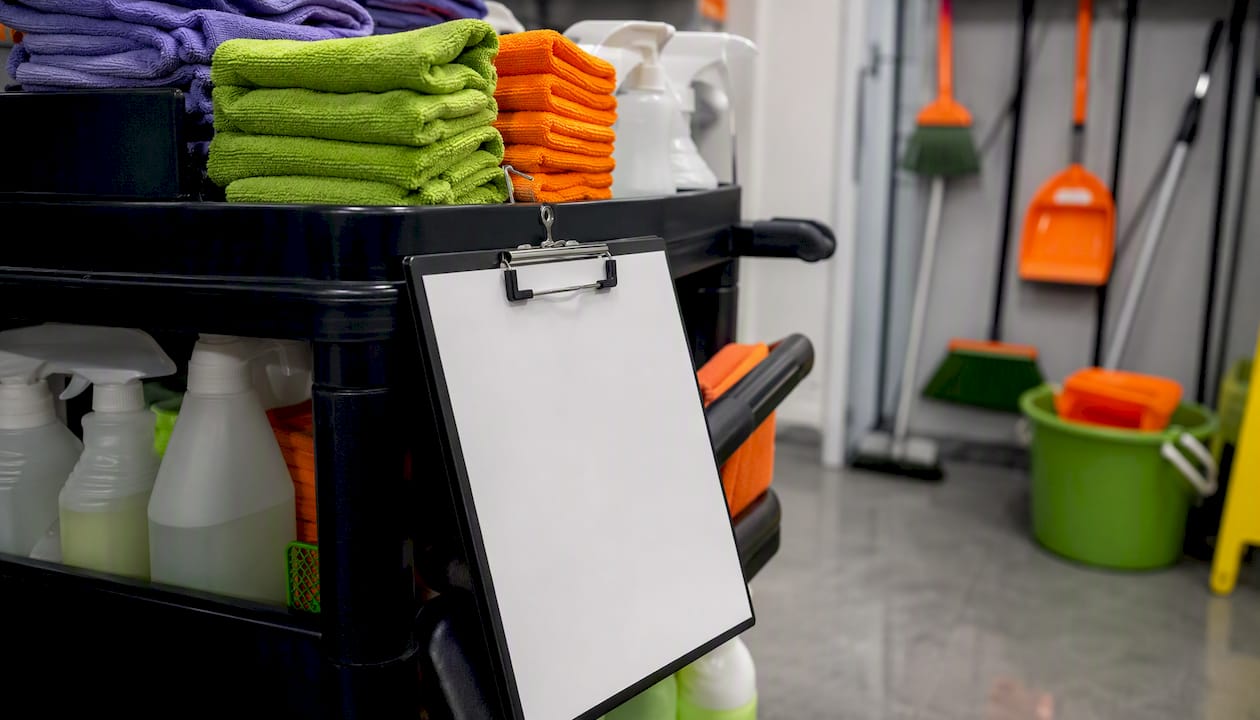
Here is your ready-to-use office cleaning checklist — one page, three cadences, copy it now and hand it to your crew today.
Daily tasks
- Empty all waste bins and replace liners; remove recycling to designated collection points
- Disinfect high-touch surfaces: door handles, light switches, elevator buttons, shared keyboards, and reception counters
- Clean and disinfect all restroom fixtures, replenish soap, paper towels, and toilet paper
- Wipe down break room counters, sinks, and appliance exteriors (microwave, coffee maker, fridge handle)
- Vacuum or sweep entrance mats and hard-floor lobbies
- Spot-clean glass entry doors and partition glass
- Mop hard floors in restrooms and break rooms
- Remove any visible spills or debris from workstation aisles
Weekly tasks
- Dust all horizontal surfaces: desks (unoccupied), shelving, window ledges, and partition tops
- Wipe interior glass, mirrors, and partition panels
- Damp-mop all hard-floor areas
- Clean interior of microwave and wipe fridge exterior thoroughly
- Disinfect shared phones, copier touchscreens, and printer panels
- Vacuum upholstered chairs and soft furnishings
- Restock all consumable supplies (soap, liners, paper products) to par level
- Inspect and clean floor drains in restrooms and break rooms
Monthly tasks
- Deep-clean refrigerator interior; discard expired items
- Scrub grout lines in restrooms and break rooms
- Wipe down all baseboards, door frames, and wall vents
- Clean light fixtures and diffusers
- Inspect HVAC vents and replace or clean filters as needed
- Shampoo or extract carpet in high-traffic zones
- Polish or refinish hard floors per manufacturer guidance
- Audit consumable par levels and update stock orders
Printable callout: Print this page and laminate it for the janitor closet door, insert it into your site binder, or paste the task text directly into your CMMS work-order description field. Date and initial each column after every completed route.
Key takeaways
A structured office cleaning checklist built around daily, weekly, and monthly cadences, with assigned owners and documented proof of completion, is the single most reliable way to maintain hygiene standards and prevent chronic maintenance failures.
| Point | Details |
|---|---|
| Daily priorities are non-negotiable | Restrooms, high-touch surfaces, and break rooms must be cleaned every day — consequence of failure is immediate. |
| Five fields make a task schedulable | Every task needs a zone, frequency, owner, acceptance standard, and record method before it belongs in a live schedule. |
| Pilot before you publish | Run the schedule on one floor for two weeks, measure actual completion times, and adjust par levels before rolling out site-wide. |
| Match format to site complexity | Paper works for small single-site offices; move to a spreadsheet or CMMS like Janitorial Manager once you manage multiple shifts or sites. |
| Ateliermaids removes the operational burden | Dedicated crews, service reports after every visit, and flat pricing make it straightforward to hand off the schedule and hold a provider accountable. |
Table of Contents
- Office cleaning checklist: printable template with daily, weekly, and monthly columns
- Zone-by-zone room checklists
- What belongs in daily, weekly, monthly, and quarterly cleaning cycles
- Who should do what: in-house staff, day porter, night crew, and specialist vendor
- How to turn a checklist into an operational schedule
- Checklist template variants: printable PDF, spreadsheet, and CMMS fields
- Specialised checklist variants for specific environments
- Supervisor closing checklist and quality audit methods
- How Ateliermaids approaches consistent office cleans
- Ateliermaids office cleaning: skip the setup, get the result
- Frequently asked questions
- Sources
Office cleaning checklist: printable template with daily, weekly, and monthly columns
The table below is designed to be copied into Excel, Google Sheets, or a basic work-order tool. Each row maps a task to its cadence, assigns an owner role, sets an acceptance standard, and captures proof of completion. Adjust the “Est. time” column by multiplying the base figure by 1.5 for sites over 5,000 sq ft or by 2 for high-traffic floors with more than 50 occupants.
Scaling time by square footage: a 2,000 sq ft single-floor office typically runs a full nightly route in 60–90 minutes. Add roughly 30 minutes per additional 1,000 sq ft of open-plan space, and budget separately for each restroom and break room regardless of floor size.
Checklist libraries like SafetyCulture provide copyable templates grouped by zone with built-in signature fields — useful if you want a formatted PDF without building one from scratch.
Signature block (copy to bottom of each printed sheet):
Cleaner name: ___________ Signature: ___________ Date: ___________ Supervisor name: ___________ Signature: ___________ Date: ___________ Notes / skipped areas: ___________________________________________
Zone-by-zone room checklists
Room-by-room task lists keep crews from guessing and give supervisors a clear acceptance standard for every space. Allied Facility Care’s commercial checklist separates daily visible work from weekly and monthly resets — the same logic applied here.
Reception and lobby
Daily: Disinfect reception desk, door handles, and any shared pens or sign-in tablets. Vacuum entrance mat. Spot-clean glass doors (both sides). Empty waste bin and replace liner. Wipe any seating armrests.
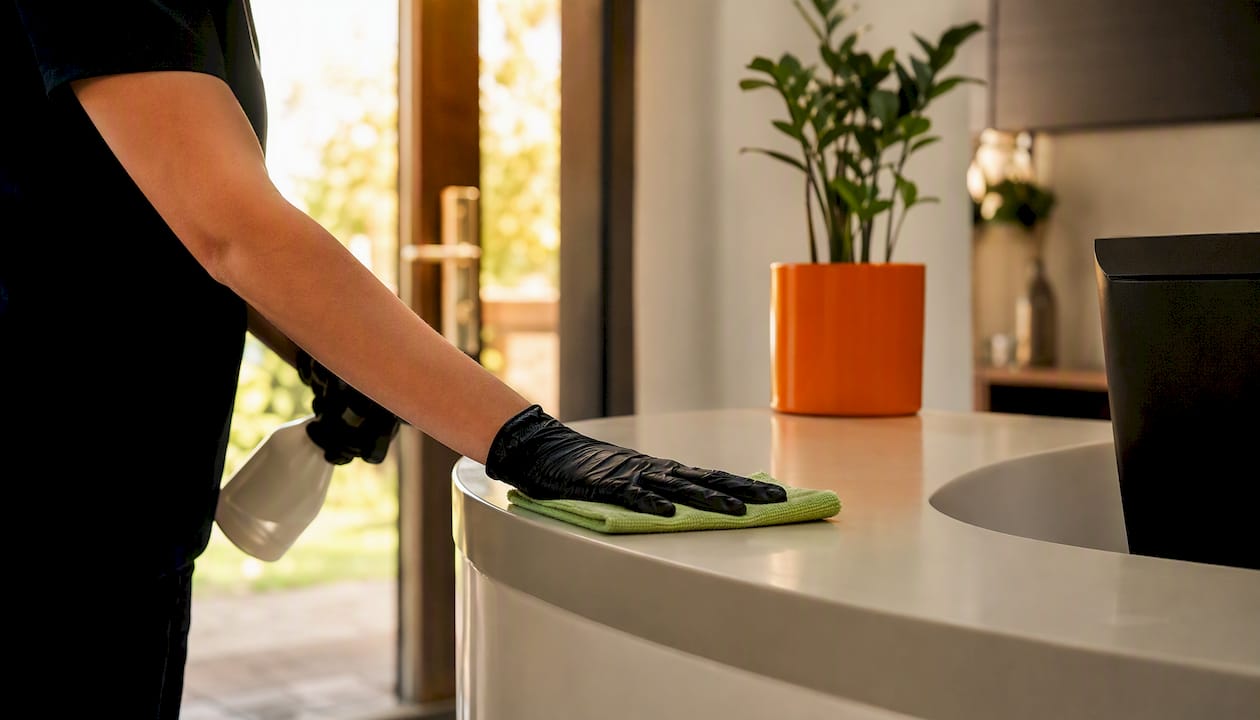
Weekly: Dust display shelves, signage, and any decorative surfaces. Wipe interior glass panels and mirrors. Damp-mop hard floors.
Periodic: Clean light fixtures and ceiling vents quarterly. Shampoo lobby carpet or refinish hard floors every 3–6 months depending on foot traffic.
Do not move personal items left at the reception desk. If a visitor’s bag or personal document is on the counter, clean around it and note it in the skipped-areas field.
Open office and workstations
Daily: Empty all waste bins and replace liners. Disinfect shared surfaces (printer panels, copier touchscreens, shared phones). Spot-clean any visible spills.
Weekly: Dust unoccupied desks, shelving, and partition tops. Vacuum all carpeted areas wall-to-wall. Wipe window ledges.
Periodic: Clean upholstered chairs monthly. Wipe baseboards and wall vents monthly.
Do not move personal items on individual desks. Clean only the clear surface area around them. Do not open drawers, move monitors, or handle personal documents.
Meeting rooms
Daily: Wipe conference table and all chair armrests. Disinfect AV remote controls, video-conferencing panels, and light switches. Empty bin and replace liner. Straighten chairs.
Weekly: Wipe whiteboard tray and clean whiteboard surface. Dust shelving and any credenzas. Vacuum carpet or damp-mop hard floor.
Periodic: Clean projector lens cover and ceiling vents quarterly.
Break room and kitchenette
Daily: Wipe all counters and the sink. Clean appliance exteriors (microwave door and handle, coffee maker, fridge handle). Empty bin and replace liner. Mop floor.
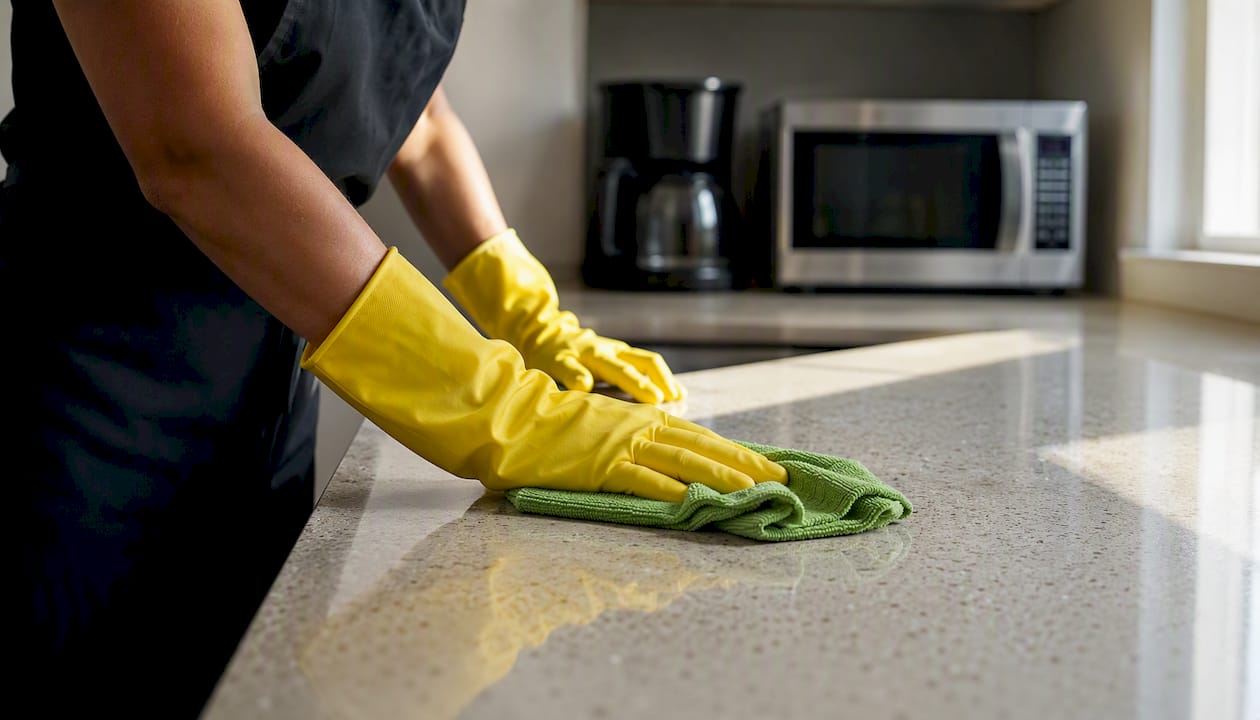
Weekly: Clean microwave interior. Wipe fridge exterior thoroughly. Disinfect sink drain area. Restock paper towels, dish soap, and any shared supplies.
Periodic: Deep-clean fridge interior monthly (discard expired items with a note to staff 24 hours in advance). Scrub grout monthly.
Pro Tip: Use a dedicated colour-coded cloth system — red for restrooms, blue for general surfaces, yellow for kitchens. This is an operational rule, not optional guidance. ZBM Clean’s guide notes that colour-coded microfibre prevents cross-contamination between food-prep and sanitation zones, which is the single most common source of bacterial transfer in office environments.
Restrooms
Daily: Disinfect all fixtures (toilets, urinals, sinks, faucet handles, flush handles, dispensers). Mop floor with an EPA-registered disinfectant. Replenish soap, paper towels, and toilet paper. Empty sanitary bins. Wipe mirrors.
Weekly: Scrub tile walls. Clean floor drains. Wipe partition doors and hardware.
Periodic: Scrub grout monthly. Inspect and clean exhaust vents monthly.
PPE rule: Gloves and eye protection are mandatory in restrooms. Change gloves before moving to any other zone.
Copy room and support areas
Daily: Wipe copier and printer surfaces. Empty waste bin. Spot-clean any toner spills immediately (toner is a respiratory irritant — wear a dust mask).
Weekly: Dust shelving and supply cabinets. Wipe door handles and light switches.
Exterior entry and stairwells
Daily: Sweep or blow exterior entry. Wipe exterior door handles. Check for litter within 3 metres of the entrance.
Weekly: Mop stairwell landings. Wipe handrails with disinfectant.
Periodic: Power-wash exterior entry quarterly (or after winter).
Storage and IT rooms
Weekly: Sweep or vacuum floor. Wipe door handles.
Periodic: Dust server cabinet exteriors and cable management trays monthly (do not touch cables or equipment). Confirm with IT before entering server rooms; log entry and exit times.
What belongs in daily, weekly, monthly, and quarterly cleaning cycles
Frequency decisions come down to two factors: consequence of failure and traffic volume. A restroom that goes uncleaned for 48 hours creates a health and reputational problem; a storage room that goes undusted for two weeks does not.
Daily cleaning in high-traffic areas can reduce germ presence by roughly 80%, and structured programmes have been associated with 15–25% reductions in sick days — which is the clearest argument for keeping daily tasks tight and non-negotiable.
The decision rule:
- Daily — any surface touched by multiple people, any area where food or waste is handled, any floor zone with more than 20 passes per hour.
- Weekly — surfaces that accumulate dust or light soil but pose no immediate health risk if missed one day (desks, glass, upholstery).
- Monthly — tasks that protect assets or prevent chronic issues: grout, vents, baseboards, floor care.
- Quarterly / deep clean — tasks that require specialist equipment or cause operational disruption: carpet extraction, floor refinishing, duct cleaning, upholstery steam cleaning, high-level dusting above 2.5 metres.
| Task | Cadence | Recommended tool / product | Notes |
|---|---|---|---|
| Disinfect high-touch surfaces | Daily | EPA-registered disinfectant; microfibre cloth | Follow label dwell time — typically 30–60 seconds |
| Empty waste bins | Daily | Liner replacement each visit | Separate recycling stream |
| Mop restroom and break room floors | Daily | Microfibre flat mop; neutral pH cleaner | Colour-coded mop heads by zone |
| Vacuum carpets (high-traffic) | Daily or every other day | HEPA-filter upright or backpack vacuum | Reduces allergen load |
| Dust horizontal surfaces | Weekly | Dry microfibre duster | Unoccupied desks only |
| Damp-mop all hard floors | Weekly | Microfibre flat mop; neutral cleaner | Buff dry to prevent slip hazard |
| Clean fridge interior | Monthly | Food-safe all-purpose cleaner | Notify staff 24 hours in advance |
| Scrub grout | Monthly | Grout brush; pH-neutral tile cleaner | Prevents odour and staining |
| Clean HVAC vents / replace filters | Monthly | Damp cloth; replacement filter | Check filter type before ordering |
| Carpet extraction | Quarterly | Truck-mount or portable extractor | Outsource to certified vendor |
| Floor refinishing (VCT, hardwood) | Quarterly or semi-annually | Burnisher; floor finish per manufacturer | Outsource if no in-house equipment |
| High-level dusting (above 2.5 m) | Quarterly | Extension duster; scissor lift if needed | Safety harness required above 3 m |
| Upholstery steam cleaning | Semi-annually | Commercial steam cleaner | Outsource for large volumes |
| Duct and vent deep cleaning | Annually | Specialist HVAC contractor | Required in most commercial leases |
Outsource these deep-clean tasks rather than attempting them in-house without the right equipment: carpet extraction, floor refinishing, duct cleaning, and any work above 3 metres. The risk of asset damage or a workplace injury outweighs the cost of a specialist.
Who should do what: in-house staff, day porter, night crew, and specialist vendor
Dividing tasks by role prevents gaps and avoids paying specialist rates for routine work. Nexus Facility Services recommends matching daytime porter touch-ups with nightly resets to keep high-traffic areas presentable throughout the day.
According to Statista’s data on facility management outsourcing, outsourcing cleaning services is a common operational choice across facility portfolios — particularly for nightly crews and specialist deep-clean work.
After-hours access checklist
Before a night crew enters the building, confirm the following:
- Keys or access cards issued and logged with security
- Alarm code provided and entry/exit times recorded
- Locked rooms (server rooms, executive offices, storage) identified and marked “do not enter” on the route map
- Emergency contact number posted in the janitor closet
- Crew sign-in and sign-out log completed each visit
When the crew leaves: confirm all lights are off in cleaned zones, all doors are re-locked, alarm is re-armed, and the sign-out log is completed with any issues noted.
Escalation protocol
Any of the following requires an immediate report to the facility manager, not just a note in the log:
- Biohazard spill (blood, vomit, sharps)
- Structural damage (broken fixture, water leak)
- Supply outage that cannot be resolved from on-site stock
- Security concern (unlocked door, missing key)
- Health complaint from a building occupant
Pro Tip: Keep a one-page escalation card in the janitor closet with the facility manager’s mobile number, the building’s emergency maintenance line, and the after-hours security contact. A crew member should never have to search for these numbers at 11 PM.
How to turn a checklist into an operational schedule
A checklist on paper is a starting point. An operational schedule is what actually gets the work done consistently. Facility Management Insights recommends starting with a building walk — observe traffic patterns, map zones, and only then formalise task frequencies.
Every recurring task in your schedule needs five fields:
- Zone — the specific area (e.g., “2nd floor women’s restroom,” not just “restroom”)
- Frequency — daily, weekly, monthly, or quarterly
- Owner — the role responsible (day porter, night crew, facility staff, vendor)
- Expected result — the acceptance standard in plain language (“no visible soil, supplies full, no odour”)
- Record method — how completion is proved (initials, timestamp, photo, supervisor signature)
| Field | Example entry | Why it matters |
|---|---|---|
| Zone | 3rd floor open office, east wing | Prevents ambiguity across multi-floor sites |
| Task | Vacuum carpet wall-to-wall | Defines scope so nothing is assumed |
| Frequency | Weekly (Monday night) | Sets expectation and enables audit |
| Owner | Night crew, lead cleaner | Single point of accountability |
| Expected result | No debris, no matting visible | Gives supervisor a pass/fail standard |
| Record method | Initials + timestamp in CMMS | Creates audit trail |
Migrating to a CMMS or work-order platform
Paper checklists work for a single small office. Once you manage multiple shifts or sites, move tasks into a CMMS or work-order platform. Tools like Janitorial Manager integrate checklists, work-order tracking, and KPI dashboards so supervisors can audit completion rates without walking every floor every night.
To migrate: export your master task list as a CSV with the five fields above, then import into the platform’s task library. Assign each task to a route, set the recurrence, and attach the acceptance standard as the task description.
Pro Tip: Before you go live with a new schedule, run a two-week pilot on one floor or zone. Track actual completion times against your estimates, note any tasks that are consistently skipped, and adjust par levels for consumables based on real usage. A schedule built from observation beats one built from assumptions every time.
Checklist template variants: printable PDF, spreadsheet, and CMMS fields
The right format depends on site complexity and team size.
Printable PDF or paper checklist Best for: single-site offices under 3,000 sq ft with one or two cleaners.
Columns to include: Zone, Task, Frequency, Cleaner initials, Date, Supervisor initials, Notes.
Print double-sided, laminate the daily sheet, and replace the weekly/monthly sheet at the start of each period. Store completed sheets in a site binder for 90 days minimum.
Spreadsheet (Excel or Google Sheets) Best for: small to mid-size offices with 2–5 cleaners and a single supervisor.
| Column | Purpose |
|---|---|
| Area / zone | Specific room or floor |
| Task description | Plain-language task |
| Frequency | Daily / weekly / monthly / quarterly |
| Owner role | Day porter / night crew / vendor |
| Est. minutes | Time budget per task |
| Acceptance criteria | Pass/fail standard |
| Evidence field | Initials, photo link, or timestamp |
| Supervisor sign-off | Name and date |
Protect the header row and frequency column from editing. Share via a shared drive so supervisors can verify completion without being on-site.
CMMS or work-order platform Best for: multi-site portfolios, facilities with shift changes, or any site requiring a full audit trail.
Required fields mirror the five operational fields above. Add: work-order number, assigned technician ID, completion timestamp, and photo attachment. ZBM Clean’s guide notes that cleaning, sanitising, and disinfecting are distinct processes — your CMMS task descriptions should specify which process applies to each task and require the cleaner to confirm the disinfectant dwell time was observed.
Pros and cons at a glance:
- Paper: zero setup cost, works offline, no training required — but no audit trail, easy to lose, and impossible to aggregate across sites.
- Spreadsheet: low cost, flexible, easy to share — but version control is fragile and timestamps require manual entry.
- CMMS: full audit trail, real-time visibility, KPI dashboards — but requires setup time, training, and a monthly software cost.
Specialised checklist variants for specific environments
Medical and dental offices
Standard office cleaning protocols are a baseline, not a ceiling, in clinical settings. Modifications required:
- Disinfect all patient-contact surfaces (chairs, armrests, counters, door handles) between every appointment, not just daily
- Use hospital-grade disinfectants with documented kill claims for bloodborne pathogens
- Separate waste streams: regulated medical waste, sharps containers, and general waste each require distinct handling and disposal routes
- Log every cleaning event with time, product used, and cleaner name — this is a regulatory requirement in most Canadian provinces
- Restrict access to cleaning staff who have completed WHMIS training and, where required, bloodborne pathogen training
A regulatory caveat applies here: medical and dental facilities should follow the infection prevention and control (IPAC) protocols issued by their provincial health authority and engage a certified clinical cleaning vendor for any procedure-room or operatory cleaning.
Pro Tip: For dental offices specifically, the suction line and trap cleaning protocol is separate from the surface cleaning checklist. Confirm with the practice manager that the dental unit waterline maintenance schedule is documented independently and not conflated with the general cleaning log.
Home office variant
A home office needs a lighter version of the office checklist. Weekly priorities: dust all surfaces, vacuum floor, disinfect keyboard and mouse, wipe monitor screen with a dry microfibre cloth. Monthly: clean window interior, wipe baseboards, check under-desk cable management for dust accumulation. For home office setup and organisation tips that complement a cleaning routine, including door and storage considerations, that resource covers the physical environment side.
Shared workspaces and co-working environments
- Implement a clear-desk policy: all personal items must be stored in lockers before the cleaning crew arrives
- Wipe all shared desks, monitors, and peripherals after each booking block, not just nightly
- Locker exteriors cleaned weekly; locker interiors cleaned only when vacated and logged
- Post the cleaning schedule visibly so members know when areas will be unavailable
Supervisor closing checklist and quality audit methods
A supervisor audit is not a second clean — it is a verification pass that confirms the crew met the acceptance standard and flags zones that need more resources or a different approach.
Supervisor closing checklist
Before signing off on a completed route, a supervisor should confirm:
- All bins emptied and liners replaced in every zone
- Restrooms: no odour, supplies full, fixtures visibly clean, floor dry
- Break room: counters clear, appliances wiped, floor mopped
- High-touch surfaces disinfected (door handles, light switches, shared equipment)
- No personal items moved or disturbed
- Skipped areas documented with reason in the log
- Consumable stock checked; reorder flag raised if any item is below par
- Crew sign-out log completed with exit time and any issues noted
Inspection scorecard fields
KPIs to track
- Completion rate: percentage of scheduled tasks completed per route, per week
- Re-clean rate: percentage of zones that required a corrective re-clean after supervisor inspection
- Average inspection score: aggregate pass rate across all scorecard items per site per month
- Complaint volume: number of occupant-reported cleaning issues per month
- Time-to-response: average time between a complaint being logged and a corrective action being completed
Review these five KPIs in a weekly site performance meeting.
How Ateliermaids approaches consistent office cleans
Consistency in commercial cleaning comes down to one thing: the same crew, the same route, the same standard, every visit. Ateliermaids builds its office cleaning programmes around dedicated crews assigned to each client’s space. Because the same team returns every visit, they learn the overlooked spots — baseboards, vent covers, the gap behind the reception desk — that a rotating crew misses on the first pass and never comes back to.
After every visit, Ateliermaids provides a service report. That report is the proof-of-completion field the operational framework in this guide calls for: a timestamped record that a supervisor can review without walking the floor. Flat pricing removes the ambiguity that comes with hourly billing, and every team is insured and background-checked, which matters for after-hours access and locked-room protocols.
Ateliermaids office cleaning: skip the setup, get the result
Building a cleaning schedule from scratch takes time. Running it reliably takes even more.
Whether you need a recurring janitorial programme or a one-time deep clean to reset a neglected space, the team arrives vetted, insured, and ready to follow the exact scope you set. Request a quote for office cleaning and have a dedicated crew on-site without the overhead of managing the schedule yourself.
Frequently asked questions
What should be on a daily office cleaning checklist? At minimum: empty all waste bins, disinfect high-touch surfaces (door handles, light switches, shared equipment), clean and restock restrooms, wipe break room counters and appliances, spot-clean entry glass, and mop restroom and break room floors. These tasks address the highest-consequence areas and should never be deferred.
How long does a nightly office clean take? A typical nightly route for a 2,000 sq ft single-floor office runs 60–90 minutes. Budget an additional 30 minutes per 1,000 sq ft of open-plan space, and add time separately for each restroom (8–12 minutes each) and break room (10–15 minutes).
What is the difference between cleaning, sanitising, and disinfecting? Cleaning removes visible soil and debris. Sanitising reduces microbial load to a safe level. Disinfecting kills a defined spectrum of pathogens using an EPA-registered product applied at the label-specified dwell time. All three are distinct steps — disinfecting a surface that has not been cleaned first is less effective because organic matter blocks the disinfectant’s contact with the surface.
How do I divide tasks between in-house staff and a cleaning vendor? Day porters handle midday touch-ups, restocking, and lobby maintenance during business hours. A night crew handles the full nightly clean across all zones. Specialist vendors handle deep-clean tasks requiring equipment or certification: carpet extraction, floor refinishing, duct cleaning, and upholstery steam cleaning. Facility staff manage HVAC filter checks and any task requiring building-system access.
What KPIs should I track for office cleaning? Track five: completion rate (tasks completed vs scheduled), re-clean rate (zones requiring corrective action), average inspection score, complaint volume from occupants, and time-to-response on complaints. Review weekly.
When should I use a CMMS instead of a paper checklist? Switch to a CMMS or work-order platform when you manage more than one shift, more than one site, or when you need a timestamped audit trail for compliance. For a single small office with one cleaner, a laminated paper checklist and a site binder are sufficient.
Sources
The following sources informed this guide and are worth bookmarking for deeper procedures, downloadable templates, and frequency rationale:
- Office Cleaning Schedule Template: A Complete Guide (2026)
- Office Cleaning Schedule Checklist: Daily & Weekly | Free Template
- Commercial Office Cleaning Checklist (Daily to Quarterly) - Allied Facility Care