Hiring a cleaner your pets can trust: what to check first
Hiring a cleaner your pets can trust: what to check first
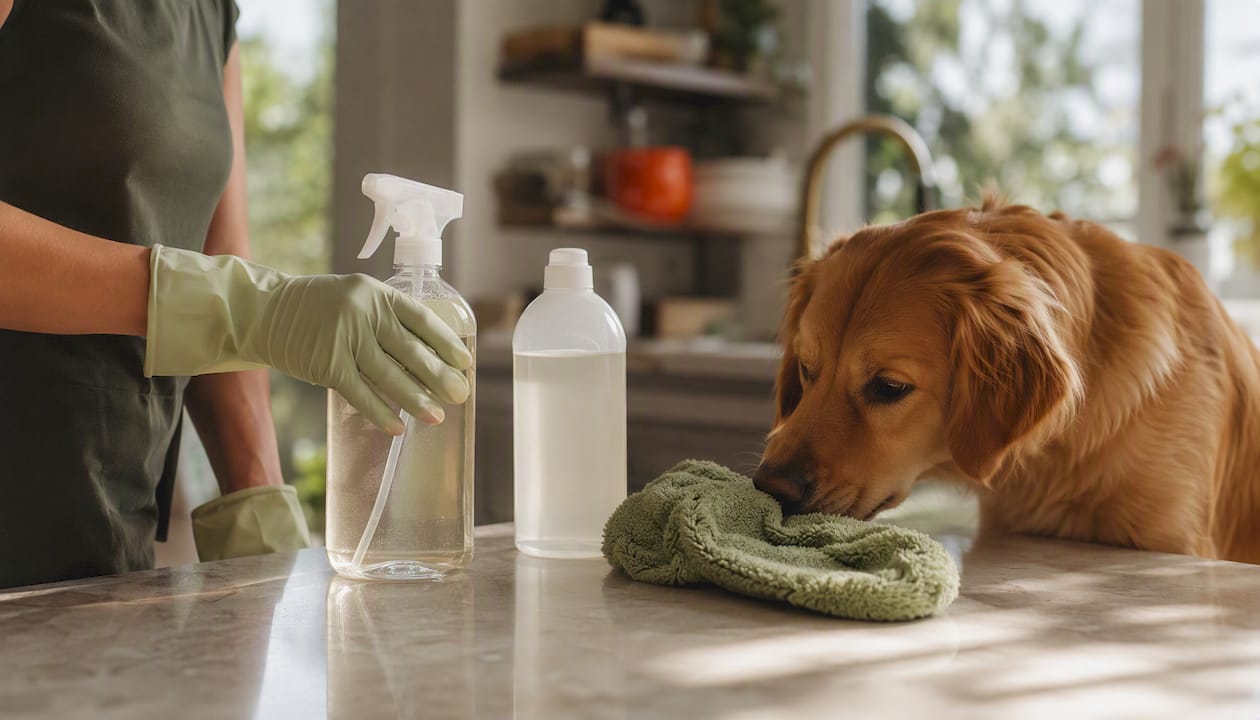
Hire a cleaning company that can name its products, hand over SDS/MSDS sheets on request, and describe a written pet plan before it sets foot in your home. That is the whole test. If a provider hesitates on any of those three things, keep calling around.
Ateliermaids builds pet-aware cleaning into its standard process rather than treating it as a special request, which is why it’s worth putting at the top of your shortlist. Before you book anyone, though, do this:
- Ask for a written list of the products the crew plans to use in your home.
- Request SDS/MSDS documentation for anything classified as a disinfectant.
- Get a one-paragraph pet plan covering confinement, ventilation, and re-entry timing.
- Confirm the crew carries insurance and has passed a background check.
Once you have those three documents in hand, you’re not guessing anymore. You’re comparing paper.
Key Takeaways
A pet-safe clean depends on named products, verifiable SDS documentation, and a written pet plan, not on marketing language alone.
| Point | Details |
|---|---|
| Request product names and SDS | Ask before booking, not on the day of service, so you have time to flag concerns. |
| Confirm HEPA and microfibre use | These reduce airborne dander and chemical reliance without extra cost to you. |
| Insist on a written pet plan | Cover confinement, ventilation, and re-entry timing in writing before the crew arrives. |
| Watch for the red flags | No product names, default bleach or phenol use, or no insurance are disqualifying signs. |
| Use service reports to track changes | A documented history helps you and the crew adjust for your pet over time. |
| Ateliermaids builds this in as standard | Flat pricing, dedicated insured crews, and pet-specific service reports come with every booking. |
Table of Contents
- What counts as pet-safe professional cleaning
- What should a cleaner ask you before the first visit?
- Which cleaning products and methods are actually pet-safe?
- How should pets be handled before, during, and after the clean?
- What proof should a trustworthy provider give you?
- What does pet-safe cleaning cost compared to a standard clean?
- What red flags mean you should keep looking?
- How does Ateliermaids handle pet-safe cleaning?
- Why we treat pet safety as a default, not an add-on
- Ready to book a pet-safe clean?
- Sources
What counts as pet-safe professional cleaning
Pet-safe professional cleaning means a company selects products and sequences its work specifically to avoid harming animals living in the home, not that it uses some certified “pet cleaning” product line. There’s no single regulatory badge that guarantees this. It comes down to ingredient choices, equipment, and procedure, verified case by case.
A pet-aware service typically includes:
- Fragrance-free or low-VOC all-purpose cleaners for counters, appliances, and fixtures.
- Enzymatic treatments for accidents, vomit, or urine stains rather than masking agents.
- HEPA-filter vacuuming to capture dander and dust instead of recirculating it.
- Deep carpet extraction using pet-safe detergents with adequate rinse cycles.
- Disinfection protocols that swap high-risk actives for gentler alternatives when pets are present.
It does not include veterinary consultation, toxicology testing, or product certification. A cleaning crew can tell you what’s in the bottle and how they’ll use it. They can’t tell you whether your specific cat has an allergy, and a reputable one won’t pretend to.
Pro Tip: “Pet-friendly” on a company’s website is a marketing claim. A named product list, an SDS on request, and a documented protocol are the verifiable version of that same claim. Ask for the second thing, not the first.
What should a cleaner ask you before the first visit?
A consultation call that skips your pets entirely is itself a warning sign. Good intake conversations run through a specific set of questions, and providers who tailor product selection and room sequencing based on your answers tend to produce fewer incidents during the visit, according to guidance on finding pet-friendly cleaning providers.
- What’s your pet’s usual routine, and where do they hide or retreat when stressed?
- Does your pet have any known sensitivities, allergies, or respiratory conditions?
- Is your pet aggressive, anxious, or a flight risk around unfamiliar people?
- Where are litter boxes, cages, or aquariums located, and should those areas be avoided?
- Does your pet lick floors or furniture surfaces, which affects product dwell time and rinsing?
- Who will be home during the visit, and how should the crew handle re-entry?
Beyond questions, ask for documents. Request the product list by name, SDS/MSDS for any disinfectant, proof of HEPA-equipped vacuums, and a plain answer on insurance and background checks. Some services will even use a client-supplied cleaner if your pet has a documented sensitivity, an accommodation worth asking about directly, as several providers now note.
Pro Tip: An acceptable answer sounds like “we use Product X for counters and Product Y as our enzymatic pre-treatment, here’s the SDS.” An evasive answer sounds like “everything we use is safe” with no names attached. That vagueness is the tell.
Which cleaning products and methods are actually pet-safe?
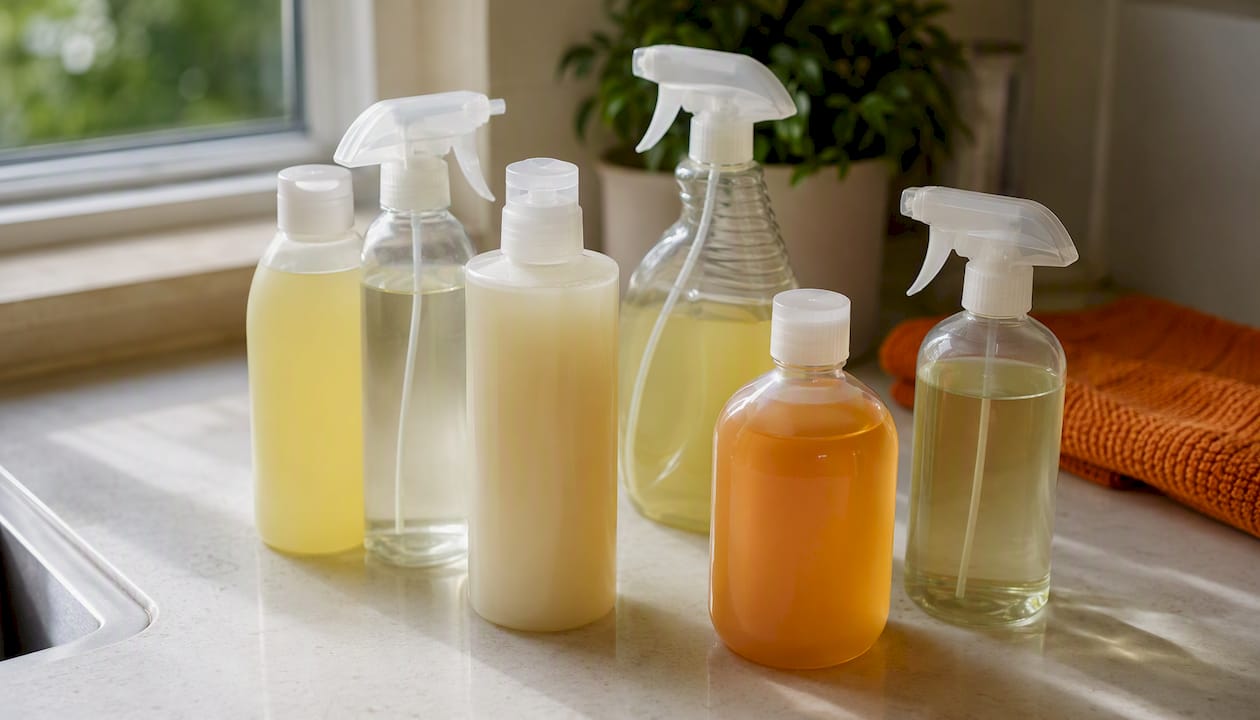
Product choice splits into categories, and each one carries its own risk profile around pets.
| Category | Pet-safe approach | What to avoid |
|---|---|---|
| All-purpose cleaners | Fragrance-free, plant-based concentrates | Heavy ammonia, synthetic fragrance loads |
| Disinfectants | Hydrogen peroxide or thymol-based formulas | Phenols, pine oil, concentrated bleach |
| Stain and odour removal | Enzymatic cleaners for organic stains | Masking fragrances over uncleaned residue |
| Floor cleaning | Microfibre plus pet-safe detergent, full rinse | Glycol ether solvents on porous flooring |
| Carpet care | Low-moisture extraction with pet-safe chemistry | High-residue shampoos left to dry unrinsed |
| Air and dust | HEPA-filter vacuums | Non-filtered vacuums that re-aerosolise dander |
Phenols and pine oils deserve particular caution because cats process certain compounds differently than dogs do, making feline households more vulnerable to those specific ingredient classes, according to Trupanion’s guidance on pet-safe cleaning. A crew servicing a cat-only home should already know to drop pine-scented products from the kit without being asked.
Enzymatic cleaners work differently than most people expect. Rather than dissolving a stain chemically, they break down the organic proteins in urine or vomit, including uric acid crystals that ordinary cleaners often leave behind, which is why they outperform standard degreasers on pet accidents specifically. And because safer disinfectant chemistries generally need more contact time to work, expect a pet-aware crew to build in slightly longer dwell times rather than wiping and moving on immediately.
How should pets be handled before, during, and after the clean?
Preparation matters as much as product choice. A property manager scheduling a turnover clean and a homeowner booking a recurring visit both benefit from the same three-phase structure.
Before the crew arrives:
- Confine pets to a secured room, crate, or outdoor space away from active work zones.
- Share emergency vet contact information and any medical notes with the crew lead.
- Point out litter boxes, cages, feeding stations, and hiding spots in writing or verbally.
- Set out any client-supplied products you want used instead of the standard kit.
During the clean, expect the crew to work room by room with doors closed behind them, keeping pets physically separated from wet floors and active chemical use. Reasonable practices include ventilating rooms with open windows or fans, changing or covering footwear between areas, and staging equipment away from pet pathways.
After the crew leaves:
- Surfaces pets can reach should be rinsed, not just wiped with product residue left behind.
- Floors need a stated drying window before pets are let back onto them.
- Reintroduce pets gradually and watch for coughing, drooling, or skin irritation over the following hours.
Sharing a written pre-visit checklist, similar to the preparation steps outlined by Limpieza Tropical, cuts down on last-minute confusion for both the crew and the animals.
What proof should a trustworthy provider give you?
Trust signals aren’t abstract. They’re documents and policies you can ask to see before signing anything.
- Insurance and background checks on every technician who enters your home.
- A flat, transparent pricing model with no surprise line items after the visit.
- A dedicated crew that returns visit after visit and learns your home’s layout and your pet’s habits.
- A written service report after each clean, noting what was done and any pet-specific observations.
- A satisfaction guarantee that gives you recourse if something is missed or done wrong.
SDS/MSDS sheets sound intimidating, but you’re only checking three lines: the residue and rinse requirements, inhalation risk warnings, and first-aid measures listed for the product. A crew willing to walk you through those lines, rather than just emailing a PDF and moving on, is showing you they actually understand the document.
HEPA-grade equipment is worth confirming specifically, because that filtration standard captures 99.97% of particles down to 0.3 microns, according to research on pet-aware cleaning company selection, which matters directly for dander and dust-mite control in a home with shedding animals.
What does pet-safe cleaning cost compared to a standard clean?
Pet-aware practices add real cost in a few specific places, and understanding where helps you judge whether a quote is fair.
Most residential providers price one of three ways: a flat per-visit rate, a tiered package (basic, deep, move-out), or a contract rate for recurring service. Add-ons for enzymatic stain treatment or full carpet extraction usually sit outside the base price because they require different equipment and more time.
- Product cost runs higher for enzymatic and fragrance-free formulas than for bulk conventional cleaners.
- Longer dwell times for safer disinfectants slow down the visit slightly, which factors into labour cost.
- Specialised equipment, particularly HEPA vacuums and carpet extractors, represents a capital investment that shows up in the rate.
- Crew training and consistency cost more to maintain than rotating anonymous staff pools.
None of that should mean a blank cheque. A reasonable provider gives you a written price breakdown before the first visit and sticks to it. If a quote balloons without a clear explanation tied to one of the factors above, ask for an itemized answer before you approve the charge.
What red flags mean you should keep looking?
Some warning signs show up on the phone, before a single mop touches your floor.
- The company can’t or won’t name the specific products it plans to use.
- It refuses to provide SDS/MSDS documentation when asked directly.
- Bleach, pine-oil cleaners, phenols, or heavy ammonia are the default kit, not the exception.
- Heavy synthetic fragrance is used to signal “clean,” masking rather than removing odour.
- No HEPA-filter vacuum is part of the standard equipment list.
- There’s no plan for securing pets beforehand or reintroducing them afterward.
- Crews rotate constantly with no consistent lead technician assigned to your home.
- The company can’t produce proof of insurance or background-checked staff on request.
Any single item on that list is worth a follow-up question. Two or more, and it’s time to call the next name on your list.
How does Ateliermaids handle pet-safe cleaning?
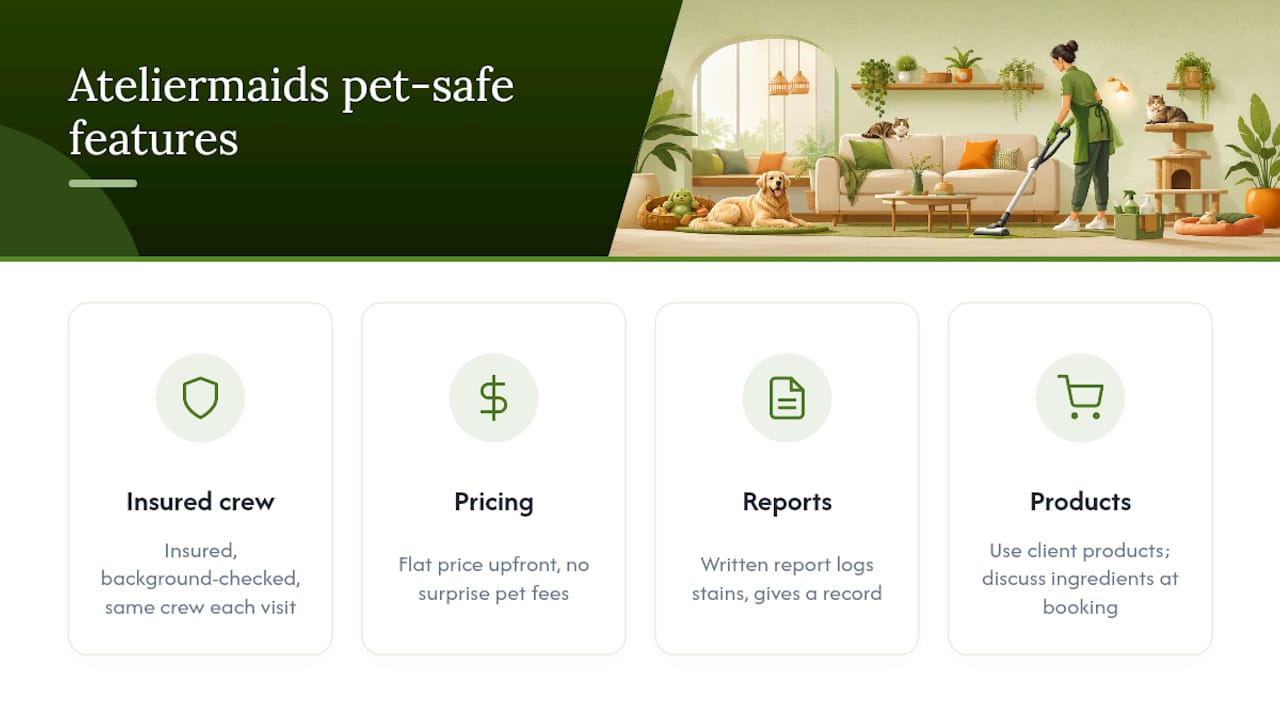
Ateliermaids builds each of the trust signals above into the standard service rather than offering them as an upsell. Every home gets an insured, background-checked crew, and that crew stays dedicated to your property visit after visit instead of rotating through unfamiliar staff each time.
Pricing runs on a flat model stated upfront, so a pet-specific product swap or an enzymatic stain treatment doesn’t turn into a surprise invoice. After every visit, you receive a written service report, which becomes especially useful for pet households: the crew can log which rooms needed a longer dwell time, note stain locations, and flag anything worth watching before the next visit.
If your pet has a specific sensitivity, tell the team during booking. Ateliermaids will discuss using a client-supplied product where it’s reasonable, and can walk through ingredient categories with you before the crew ever arrives. Start that conversation through the house cleaning services page and mention your pet’s needs in the consultation request.
Pro Tip: Send your pet plan in writing, even a two-line email, before the first visit. It gives the crew lead something concrete to follow and gives you a record to reference if anything comes up later.
Why we treat pet safety as a default, not an add-on
Pet owners shouldn’t have to negotiate for basic safety. We built our standard kit around fragrance-free and enzymatic products from the start, not because pet households asked for a premium tier, but because a household without pets isn’t harmed by gentler chemistry either. The idea that pet-safe cleaning is a specialty service, priced and marketed separately, has always struck us as backwards. It should be the baseline, and everything riskier should be the opt-in.
What actually protects your animals isn’t a label on a bottle. It’s a dedicated crew who’s been in your home before and knows where the litter box sits without being told twice, insured staff you can verify, and a service report that turns “trust us” into a paper trail. That consistency is the part most companies skip because rotating staff is cheaper to manage. We think that trade-off is the wrong one for pet-owning clients, and honestly, for most clients generally.
Ready to book a pet-safe clean?
You’ve seen what a genuinely pet-aware provider looks like on paper. Booking one shouldn’t take longer than reading this article did. Ateliermaids runs on the same four steps for every new client, pet or no pet: request a consultation, share your pet’s routine and any sensitivities, confirm your dedicated crew and product list in writing, then schedule the visit.
If your pet has specific needs, mention them at the first point of contact. You can request SDS documentation ahead of time, ask about swapping in a client-supplied product, or ask the crew lead any of the consultation questions covered earlier in this article. There’s no extra hoop to jump through. It’s built into how bookings work.
Start with the full list of cleaning services to see what’s covered, or head straight to the house cleaning page if you’re ready to request a quote and a pet-specific consultation today.
Sources
- How to Choose a Cleaning Company That Understands Pet Safety
- Pet-safe cleaning products — Trupanion (pet insurance blog)
- Pet-Friendly House Cleaning: What to Know Before Booking