The questions to ask cleaners before you hand over your keys
The questions to ask cleaners before you hand over your keys
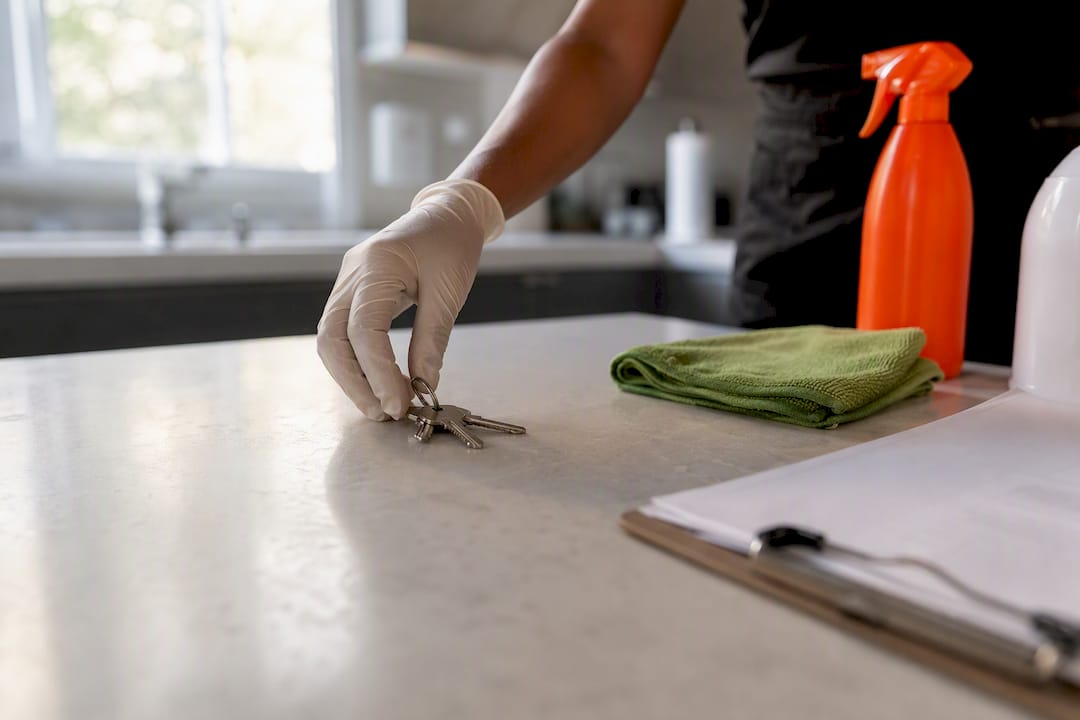
Ask for proof of insurance, a written scope of work, and details on background checks before you ask about price. Everything else in a hiring decision (schedule, products, guarantees) matters, but those three items separate a legitimate cleaning company from someone who shows up with a spray bottle and no accountability. The checklist below is written so you can read it straight off your phone during a first call and know what a good answer sounds like.
TL;DR:
- Ensure the cleaning company provides a certificate of insurance from their insurer, and verify it by email rather than a screenshot to confirm legitimacy.
- Confirm the company conducts background checks on employees and clearly explain their screening process before hiring.
- Get a detailed, written estimate specifying whether the price is flat rate or hourly, and understand what services are included or extra.
- Demand a written, room-by-room checklist of services performed and have a clear cancellation, rescheduling, and damage claim policy.
- Verify the company’s sanitation practices, product use, and key management procedures to gauge safety and professionalism.
Table of Contents
- Questions to ask cleaners: the phone-ready checklist
- Trust and safety questions to ask a cleaning company
- Pricing, contracts and cancellation policies to nail down
- What should be in a written cleaning checklist?
- What products and equipment should cleaners use in your home?
- Access, logistics and security questions worth asking
- Interview questions for vetting an individual cleaner
- What to expect after your first clean
- How to score answers and spot a red flag fast
- How Ateliermaids answers every item on this checklist
- Why most hiring advice gets this backward
- Ateliermaids: a direct option once you know what to ask
- Sources
Questions to ask cleaners: the phone-ready checklist
Read this list top to bottom on your first call or in a quote request form. Each item includes what a solid answer sounds like and the response that should make you hang up.
- “Can you email me a certificate of insurance?” A real company sends it within a day. Hesitation is a red flag.
- “Do you run background checks on employees who’ll be in my home?” Expect a clear yes with a description of the screening process.
- “Is your estimate flat rate or hourly?” Either can work, but you want a number, not a range.
- “Can I get that estimate in writing?” Anything less than yes means walk away.
- “What exactly is included in a standard clean?” Listen for specifics: baseboards, blinds, inside microwave.
- “What’s excluded unless I ask?” Fridge interiors and inside ovens are common add-ons.
- “Do you bring your own supplies, or do I need to?” Most companies supply everything unless you request otherwise.
- “Can you use my products if I have allergies or pets?” A flexible company says yes without pushback.
- “How do you handle house keys or access codes?” Look for a logged, secure system, not a casual arrangement.
- “What’s your cancellation and rescheduling policy?” There should be a defined notice window, typically 24 to 48 hours.
- “What happens if I’m not satisfied with a clean?” A real guarantee names a re-clean window.
- “Can you provide references or point me to reviews?” Recent, verifiable reviews beat a printed testimonial sheet.
- “Are your cleaners employees or subcontractors?” This affects who’s liable if something goes wrong.
- “Will I get the same cleaner or team each visit?” Consistency affects both quality and trust.
- “Do you offer a trial clean before I commit to a contract?” A company confident in its work usually says yes.
Trust and safety questions to ask a cleaning company
Insurance talk gets glossed over fast on sales calls, so slow it down. Ask specifically for a certificate of insurance (COI) that names the coverage type, the policy number, and the expiry date, and ask the company to have their insurer email it directly to you rather than forwarding a screenshot. That single step filters out a surprising number of operators who talk a good game but can’t produce paper.
Three types of coverage matter, and they protect you from different things:
- General liability insurance covers accidental property damage, like a knocked-over vase or a scratched hardwood floor.
- A surety bond protects you against theft by an employee, since a bond pays out even when an individual worker is at fault.
- Workers’ compensation protects you from liability if a cleaner is injured in your home. Without it, you could be on the hook.
Verification of licensing, bonding, and insurance through official documentation is the industry standard for a reason: it shifts risk off your homeowner’s policy and onto theirs. Also ask whether cleaners are direct employees or subcontractors. Employees usually mean tighter screening and clearer liability; subcontractors can mean a rotating cast of people you’ve never vetted, arriving with a different level of insurance coverage each time.
Pricing, contracts and cancellation policies to nail down
A flat rate makes sense for a standard recurring clean because it’s predictable and protects you from surprise hourly overages. Hourly pricing tends to fit one-off jobs with unclear scope, like a first deep clean in a home nobody’s professionally cleaned in years. Either model works, but get it in writing before the first visit.
Before you sign anything, confirm these show up in a contract or written estimate:
- The exact price and how often it’s billed (per visit, monthly invoice, and so on)
- Cleaning frequency and what happens if you need to skip a week
- A room-by-room list of included tasks, not a vague “full house clean”
- Cancellation and rescheduling terms, including any late-cancellation fee
- A documented process for filing a damage claim, including timelines
Ask directly: “What triggers an extra charge?” Good answers name specifics: a fridge deep clean, interior windows, post-renovation debris. Also ask about tipping. Some companies build gratuity into their flat rate; others leave it entirely up to the client. You want to know before, not after, the invoice lands.
What should be in a written cleaning checklist?
A standard clean and a deep clean are not the same service, and a company that doesn’t distinguish them clearly is one to question. A standard clean usually covers visible surfaces, floors, bathrooms, and kitchens on a recurring basis. A deep clean adds baseboards, window tracks, behind and under furniture, and inside appliances. A move-out clean goes further still, often including inside cabinets, closets, and light fixtures to meet a landlord’s or buyer’s standards.
Ask for a written, room-by-room checklist before you book, and treat a company’s refusal to provide one as a warning sign rather than a minor inconvenience. A structured pre-hire process groups these checks together with insurance, screening, and pricing questions for good reason: scope disputes cause more customer complaints than almost anything else in this industry.
- Ask: “Can you send me the checklist you use for a standard visit?”
- Ask: “Do baseboards, vents, and blinds get done every visit or only on request?”
- Confirm how frequency affects price: weekly and biweekly visits are usually cheaper per visit than monthly, since less buildup means less time on-site.
- A first-visit deep clean is often recommended even for recurring service, since it establishes a real baseline that later visits get measured against.
What products and equipment should cleaners use in your home?
Ask whether the company supplies all products or expects you to provide some. Most bring their own, but a company should say yes without friction when you ask to use your own fragrance-free or allergy-safe products instead.
- “Can you use products I provide if someone in my home has allergies or asthma?”
- “Do you carry any third-party certifications, like EPA Safer Choice or Green Seal, for your products?” Named certifications are verifiable; marketing words like “natural” or “non-toxic” are not.
- “Do you sanitize equipment, mops, and cloths between homes?” A company using colour-coded microfibre cloths (one colour for bathrooms, another for kitchens) is signalling real cross-contamination awareness.
- “What do you use around pets?” A specific product name beats a vague reassurance.
Access, logistics and security questions worth asking
How a company handles your keys tells you a lot about how they handle everything else. A managed lockbox or a logged key-handling system is standard; “don’t worry about it, we’ll figure it out” is not.
- “How do you manage keys or access codes between visits?”
- “What’s my arrival window, and what happens if my regular cleaner is sick?”
- “How do I reach you if something comes up the day of a visit?”
- “How should I handle pets during the clean, without giving out a permanent alarm code?”
Pro Tip: Set a temporary or guest code for your alarm system instead of your permanent one, and change it after the first few visits once you’re confident in the company’s access protocol.
Interview questions for vetting an individual cleaner
If you’re hiring a solo cleaner rather than a company, a short interview goes a long way. Technical and situational questions reveal more than a resume ever will.
- “How do you remove a red wine stain from carpet, or a grease stain from a stovetop?”
- “How do you clean marble, granite, or other surfaces that scratch or etch easily?”
- “What cleaning equipment do you bring versus expect on-site?”
- “If you accidentally damaged something, what would you do?”
- “If you found cash or jewellery while cleaning, what’s your process?”
- “How do you manage your time across a house this size?”
Listen for specificity. A strong candidate names actual techniques and products; someone evasive changes the subject or gives a one-word answer to a two-part question.
What to expect after your first clean
A satisfaction guarantee only means something if it has a defined window. Most reputable companies ask you to flag issues within 24 to 48 hours of a visit, after which they’ll send someone back to fix it at no charge.
- Ask what a service report includes: tasks completed, time spent, and notes on anything that needs follow-up.
- Photograph any pre-existing damage before the first visit, and keep every service report on file.
- Ask exactly how to report a problem and how fast a re-clean typically happens.
- If damage occurs, ask what documentation they need to process a claim through their insurance.
How to score answers and spot a red flag fast
Score each candidate on five things: COI provided without delay, a written scope or checklist, a clear background-check policy, an itemized price in writing, and defined sanitation practices between homes. A company that clears all five is worth booking; one that dodges two or more is worth skipping.
- Red flag: no COI, or a vague “we’re insured, don’t worry.”
- Red flag: evasive answers about employee screening or subcontractor use.
- Red flag: no written checklist, only a verbal promise of “we’ll do everything.”
- Red flag: pressure to sign a long-term contract before a trial clean.
A single trial clean, even at full price, tells you more than three phone calls. If a company won’t offer one, that’s often your answer.
How Ateliermaids answers every item on this checklist
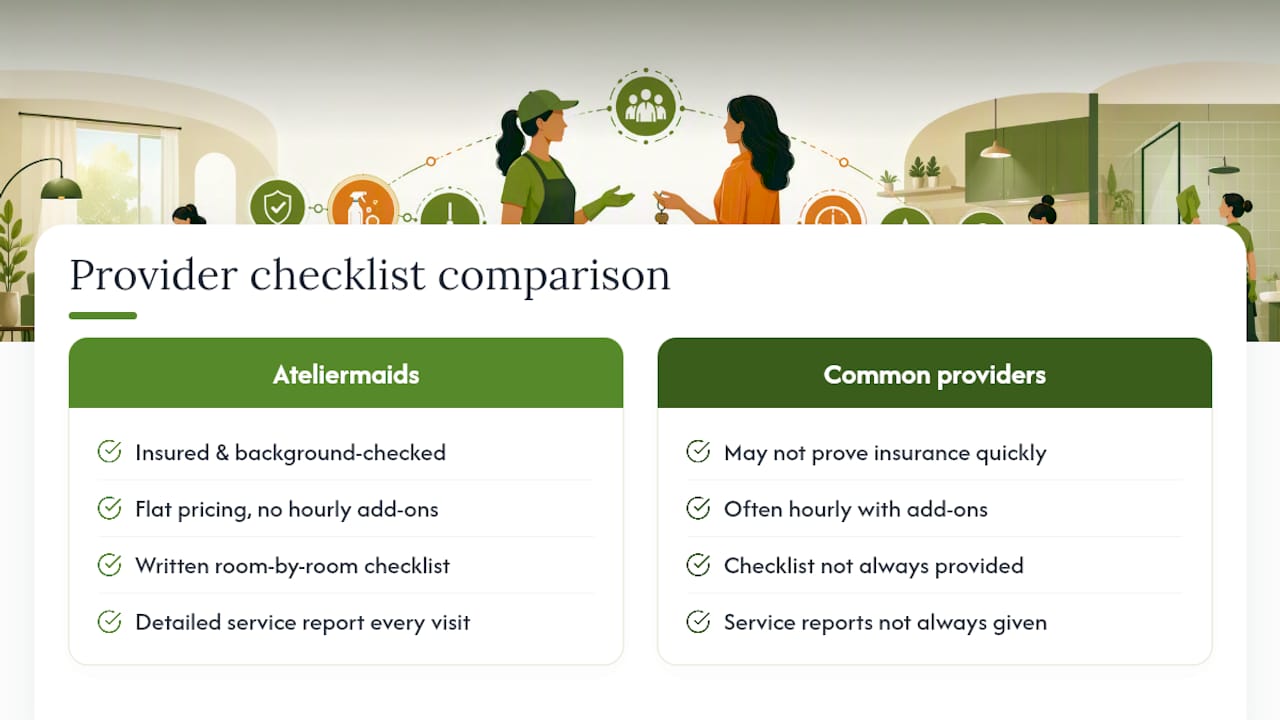
Ateliermaids works as a useful reference point precisely because it was built around these exact concerns: insured and background-checked crews, a flat pricing model instead of surprise hourly add-ons, and a detailed service report after every single visit. The satisfaction guarantee runs at 100%, and clients get the same dedicated cleaning crew visit after visit rather than a rotating, unfamiliar team.
When you’re comparing any provider against this checklist, ask for three specific documents: the certificate of insurance, a written room-by-room checklist, and a sample service report from a past client visit. A company willing to hand over all three without hesitation is one worth trusting with a key to your home.
Why most hiring advice gets this backward
Most guides tell you to start with price. That’s backward. Price is the easiest thing to compare and the least useful predictor of whether a cleaner will show up reliably, treat your home carefully, or fix a problem without an argument. The insurance and background-check questions feel bureaucratic on a first call, which is exactly why so many homeowners skip them and regret it three months in when a cleaner they’ve never vetted has a key to their house.

The bigger blind spot is scope. Homeowners assume “clean the kitchen” means the same thing to every company, and it doesn’t. A written, room-by-room checklist isn’t paperwork for its own sake. It’s the only thing that keeps a disagreement about quality from turning into a “well, I thought that was included” argument six weeks into a contract.
If you take one thing from this list, take the order: proof first, scope second, price third. A cheap cleaner with no insurance and no checklist isn’t a bargain. They’re a liability with a mop.
— Atelier
Ateliermaids: a direct option once you know what to ask
Once you’ve run through this checklist, the fastest way to see how a provider stacks up is to ask Ateliermaids directly. Every crew is insured and background-checked, pricing is flat rather than hourly, and you get a written service report after each visit instead of a vague “all done” text. You also keep the same dedicated crew for every visit, which means fewer surprises and no re-explaining your home to a new face every few weeks.
Request a written quote through the house cleaning services page, ask to see a sample certificate of insurance, and book a trial clean before committing to a recurring schedule. If you want the full rundown on how flat pricing works before you call, the pricing page breaks down what affects your quote.
Sources
- Cleaning business legal requirements (Canada) | Clean Flow Media
- Questions to ask when hiring a cleaning company | National Cleaning Authority
- 17 Go-To Questions You Should Ask a House Cleaning Service | Angi