
Tenant turnover cleaning for property managers: a practical guide
Tenant turnover cleaning for property managers: a practical guide

Tenant turnover cleaning is the full-unit reset a landlord or property manager schedules after one tenant vacates and before the next one moves in. It covers every surface an incoming tenant will touch, from oven interiors to window tracks, and it produces the documented baseline you need if a deposit dispute ever reaches a provincial tenancy board. The right sequence is straightforward: complete the move-out inspection first, finish any repairs, then schedule the turnover clean and collect before/after photos and a written service report. Do it in that order, every time, and you protect both your property and your deposit claims.
Table of Contents
- What does a turnover clean actually cover, and how is it different from a deep clean?
- The room-by-room turnover cleaning checklist you should give every contractor
- How long does a turnover clean take, and what does it cost in Canada?
- When does it make sense to use in-house staff versus a professional service?
- How do you evaluate and contract a turnover cleaning provider?
- What can Canadian landlords charge tenants for cleaning, and how do you document it?
- Why Ateliermaids is the recommended option for GTA property managers
- Key takeaways
- The turnover workflow that actually changes vacancy performance
- Book a turnover clean with Ateliermaids: what to include in your request
- Authoritative Canadian sources and documentation references
What does a turnover clean actually cover, and how is it different from a deep clean?
A turnover clean is scoped for move-in readiness. It targets every surface an incoming tenant will see or use, and it follows a defined checklist rather than a time-based approach. Turnover cleaning is sequenced to happen after repairs so the unit is photographed in its final, lettable state.
A deep clean is a different scope entirely. According to GleamSync’s comparison of the two service types, deep cleans address hidden buildup and typically cost two to three times a turnover clean. They go behind appliances, into grout lines, along baseboards, and inside vent covers. A turnover clean skips most of that hidden-grime work unless the unit’s condition demands it.
What a turnover clean typically includes that standard maintenance cleaning does not:
- Interior of all appliances (oven, fridge, microwave, dishwasher)
- Inside kitchen and bathroom cabinets and drawers
- Grout scrubbing in bathrooms and kitchens
- Odour treatment (carpets, upholstered surfaces, drains)
- Window tracks and sill channels
- Light fixture covers and vent grilles
- Thorough wipe-down of all switch plates, door handles, and baseboards
Standard recurring maintenance cleaning keeps an occupied unit presentable. A turnover clean restores it to a condition a new tenant would accept on day one. When a unit has been occupied for several years, or a tenant left it in poor condition, a deep clean may be warranted before or instead of a standard turnover scope.
The room-by-room turnover cleaning checklist you should give every contractor
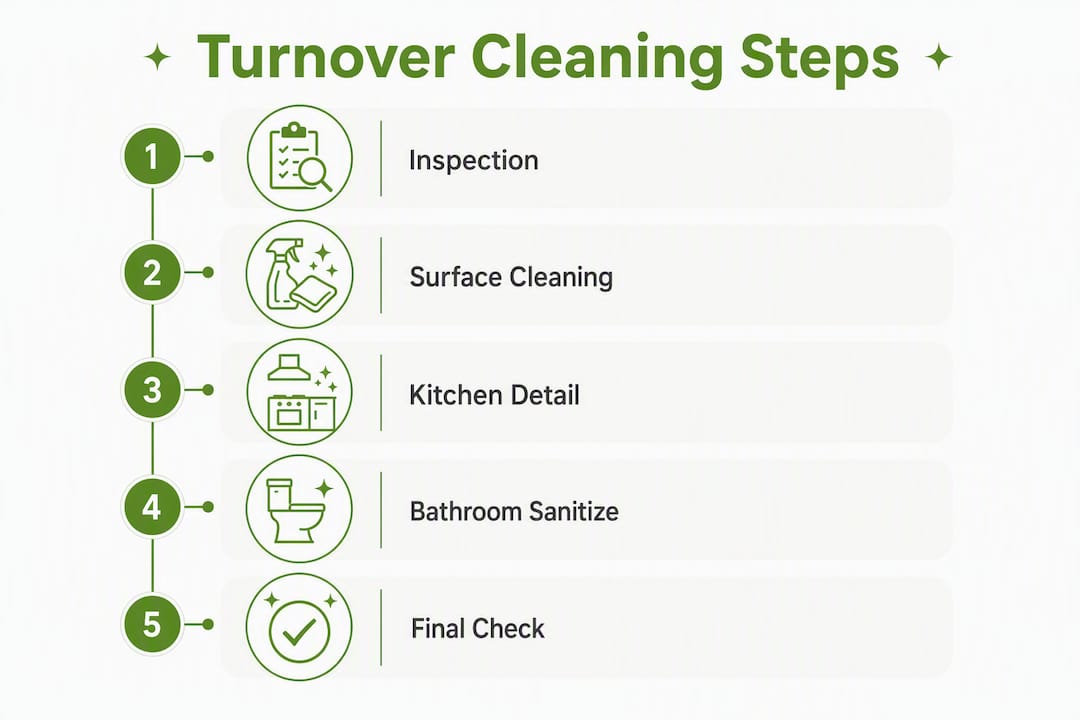
A checklist handed to a vendor before the job is the single most effective way to prevent missed items showing up on a move-in inspection. Use this as your baseline and add property-specific items.
Kitchen
- Oven interior, racks, and door seal; stovetop burners and drip pans
- Range hood filter and exterior
- Fridge interior, freezer, door seals, and top surface
- Microwave interior and exterior
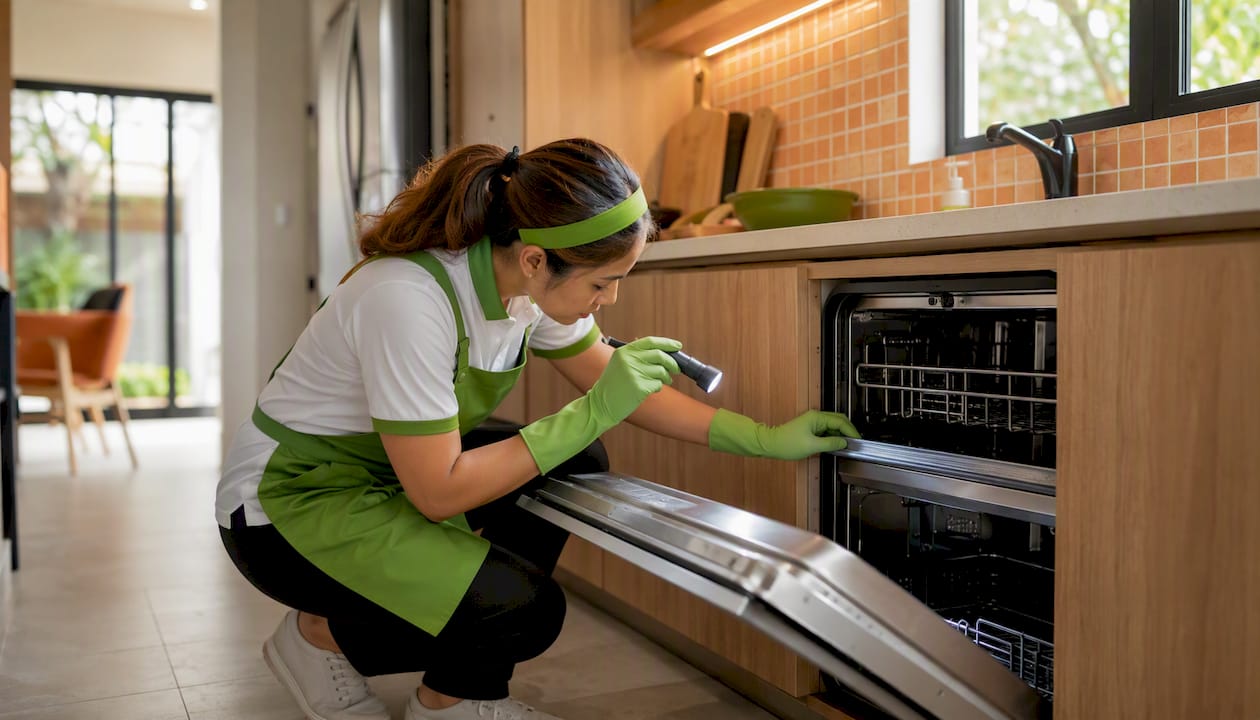
- Dishwasher interior, filter, and door seal
- All cabinet and drawer interiors
- Countertops, backsplash, and sink basin
- Behind and beneath appliances where accessible
Bathrooms
- Toilet bowl, tank exterior, seat, and base
- Shower and tub: tile, grout, fixtures, and drain
- Vanity interior, mirror, and all surfaces
- Exhaust fan cover
Bedrooms and living areas
- All closet interiors, shelves, and rods
- Window glass, frames, tracks, and sills
- Baseboards and door frames
- Light switches, outlets, and door handles
- Ceiling fan blades and light fixtures
Laundry, storage, and entry areas
- Washer and dryer interiors and exteriors
- Storage room shelves and floor
- Entry closet interior
- Front door, door frame, and threshold
Vendor deliverables you must require
- Timestamped before/after photos of every room
- Signed completion checklist with items initialled
- Written note of any damage or maintenance issues observed
- Time-on-site record
Pro Tip: Require a written service report and a full photo set from every turnover clean. That documentation becomes your post-make-ready baseline. If a new tenant later disputes the condition at move-in, you have dated, independent evidence of the unit’s state before they arrived.
How long does a turnover clean take, and what does it cost in Canada?
Time and cost both scale with unit size and condition. The time a turnover clean takes varies widely by unit size and condition, ranging from a few hours for smaller units to significantly longer for those in heavy condition with substantial soiling or odour issues.
Professional turnover cleaning services for Canadian residential units usually cost between $300 and $800, with additional charges for extra services like carpet extraction or oven cleaning.
Vacancy days cost more than the clean. Every additional day a unit sits vacant between tenants represents lost rent. A thorough, well-documented turnover clean that passes a move-in inspection on the first attempt is almost always cheaper than a second visit or a delayed relist.
| Unit size | Typical clean time | Estimated cost (CAD) |
|---|---|---|
| Studio / 1BR | 2–4 hours | $300–$400 |
| 2BR / 2BA | 3.5–5.5 hours | $400–$600 |
| 3BR | 5–7 hours | $600–$800 |
| 4BR+ or heavy condition | 7+ hours | $800+ |
Cost estimates reflect typical Canadian market ranges, with condition surcharges and add-ons (carpet extraction, oven detail) applied separately.

Schedule the clean within 24–48 hours of vacate, but only after the move-out inspection is complete. Cleaning before you inspect erases evidence you may need for a deposit claim.
When does it make sense to use in-house staff versus a professional service?
The honest answer depends on your portfolio size, how tight your vacancy windows are, and how often you face deposit disputes.
In-house cleaning tends to work when:
- You manage a small portfolio (one to three units) with predictable, low-condition turnovers
- You have a trusted, available staff member who follows a written checklist
- Vacancy windows are flexible and a second-pass clean is not a scheduling problem
- You rarely face tenancy board disputes over cleaning
Outsourcing to a professional turnover service is the stronger choice when:
- You manage multiple units with overlapping vacate dates
- Vacancy windows are tight and a failed move-in inspection would delay your relist
- You need consistent, documented results across all units
- Deposit disputes are a recurring risk and you need independent, timestamped photo evidence
- Your in-house staff lack the equipment for carpet extraction, grout cleaning, or odour treatment
The risk trade-off is real. An in-house cleaner who misses the oven seal or the window tracks is a liability when a new tenant photographs those items on move-in day. A professional service with a re-clean guarantee and photo documentation shifts that risk back to the vendor. Insurance and bonding matter too: if a cleaner damages a fixture or a surface, a properly insured contractor covers the repair. An uninsured in-house worker does not.
For managers running five or more units, the consistency argument alone usually justifies outsourcing. A recurring vendor who knows your properties develops a rhythm that an ad-hoc arrangement never matches.
How do you evaluate and contract a turnover cleaning provider?
The quote conversation is where you separate vendors worth hiring from those who will cost you more than they save.
Questions to ask on every quote:
- Is the scope itemised, or is it a flat “turnover clean” with no checklist?
- Is pricing flat per unit or hourly? If hourly, what triggers a condition surcharge?
- What is your standard lead time, and can you accommodate 24–48 hour bookings?
- Are you insured and bonded? Can you provide a certificate?
- What does your re-clean policy look like if an item is missed?
- What documentation do you provide on completion (photos, checklist, report)?
Contract clauses to require before signing:
- Written scope of work tied to a room-by-room checklist
- Flat per-unit pricing with explicit condition-surcharge triggers and caps
- Re-clean window (typically 24–48 hours after completion) and quality guarantee terms
- Proof of public liability insurance and, for multi-unit contracts, bonding
- Photo and service-report deliverables specified as a condition of payment
- Cancellation terms and emergency-response availability
Red flags that should end the conversation:
- No proof of insurance when asked
- Scope described verbally with no written checklist
- No re-clean policy or a policy that requires you to pay for a second visit
- Pricing that is entirely hourly with no cap and no condition-surcharge transparency
- No photo documentation offered as standard
Flat per-unit pricing is the most budget-predictable model for property managers. Build escalation terms into multi-unit contracts so rate adjustments require written notice and a defined review period, not a surprise invoice.
What can Canadian landlords charge tenants for cleaning, and how do you document it?
Canadian tenancy law sets a clear standard: a tenant must return the unit in a condition consistent with the documented move-in state, adjusted for reasonable wear and tear. Charging for cleaning beyond that documented baseline is the most common reason landlords lose deposit claims at provincial tenancy boards.
The documentation you create before and after each tenancy is your entire case.
The documentation checklist every manager should maintain:
- Dated move-in photos (every room, every surface) signed off by the incoming tenant
- Completed move-in condition report, co-signed at key handover
- Dated move-out inspection report completed before any cleaning or repairs
- Repair receipts with dates, scopes, and amounts
- Post-make-ready photos taken after repairs and after the turnover clean
- Vendor service report and completion checklist from the turnover clean
The correct operational sequence:
- Conduct the move-out inspection before touching anything
- Complete all repairs and document them with receipts
- Schedule and complete the turnover clean
- Collect the vendor’s photo set and service report
- Use the post-clean photos as the move-in baseline for the incoming tenant
On documentation and disputes: a structured turnover pipeline with dated receipts and photos at every stage reduces the gaps that cost rent during vacancy and gives you defensible evidence if a deposit claim goes to a board hearing.
Cleaning charges that exceed normal wear and tear, or that cannot be compared against a documented entry condition, routinely fail at adjudication. An itemised vendor invoice tied to a dated post-clean photo set is far stronger evidence than a landlord’s written description of the unit’s state.
This article provides general information for Canadian property managers and is not legal advice. Confirm current tenancy rules with your provincial tenancy authority or a qualified legal professional.
Why Ateliermaids is the recommended option for GTA property managers
For managers in the Greater Toronto Area who need documented, repeatable turnover results, Ateliermaids’s move-in/move-out service is built around the trust signals that matter most in a deposit-dispute environment.
What the service delivers:
- Dedicated crews who become familiar with each property, reducing the hidden gaps that rotate-in cleaners routinely miss (vent covers, cabinet interiors, oven seals)
- Flat pricing per job or per-unit scope, so vacancy budgets are predictable
- Detailed service reports and before/after photos delivered after every visit
- Insured and background-checked teams on every job
- 100% satisfaction guarantee with a re-clean policy that protects your move-in baseline
The service report Ateliermaids provides after each turnover clean includes a timestamped photo set, a completed checklist, and a note of any damage or maintenance issues observed during the clean. That package is exactly what a property manager needs to establish a defensible post-make-ready baseline before a new tenant takes possession.
For managers running multiple units across the GTA, a recurring contract with a single, familiar vendor also reduces the coordination overhead of sourcing ad-hoc cleaners for each vacancy. Crews who know a property catch things a first-visit cleaner will not.
Key takeaways
A well-documented, professionally executed turnover clean is the single most effective tool a Canadian property manager has for reducing vacancy days and protecting deposit claims.
| Point | Details |
|---|---|
| Document before you clean | Complete the move-out inspection before scheduling the turnover clean to preserve evidence for deposit disputes. |
| Sequence matters | The correct order is: move-out inspection, repairs, turnover clean, post-clean photos, then move-in with the new tenant. |
| Require vendor documentation | Always collect timestamped before/after photos, a signed completion checklist, and a written service report from your cleaning provider. |
| Budget by unit size | Professional turnover cleans in Canada typically cost $300–$800 for most residential units depending on size and add-ons; heavy-condition jobs and specialist tasks can increase the cost further. |
| Ateliermaids for GTA managers | Ateliermaids provides flat-rate turnover cleans with service reports, insured crews, and a satisfaction guarantee across the Greater Toronto Area. |
The turnover workflow that actually changes vacancy performance
The managers who consistently relet units fastest treat turnover as a pipeline, not a single task. Move-out walkthrough feeds the make-ready scope; the make-ready scope feeds the cleaning brief; the cleaning brief produces the photo set that becomes the move-in baseline. When every stage hands something documented to the next, the whole process accelerates.
The practical tip most managers overlook: start marketing the unit the moment you receive notice to vacate, not after the clean is done. You can photograph the unit after make-ready and use those images in your listing. By the time the turnover clean is complete, you may already have a signed lease waiting. That overlap, notice to vacate running parallel to marketing, is where vacancy days actually get cut.
Deposit disputes also drop sharply when incoming tenants sign off on a post-clean condition report at key handover. They have seen the photos. They know the baseline. The conversation about what constitutes damage versus wear and tear is much shorter when the evidence is already in front of both parties.
Book a turnover clean with Ateliermaids: what to include in your request
Faster relets start with a clean that passes inspection the first time. Ateliermaids delivers flat-rate apartment turnover cleaning across the Greater Toronto Area, with service reports and before/after photos included on every job, so you have the documentation you need before a new tenant walks through the door.

To get an accurate quote, have the following ready when you reach out: unit size (square footage or bedroom count), current condition (average, heavy soiling, or post-renovation), required lead time, and any specific add-ons such as carpet extraction or oven detail. Let Ateliermaids know you need a service report and photo set on completion, and confirm the re-clean window upfront.
For managers with multiple units or a recurring vacancy cycle, ask about ongoing contract terms. A recurring arrangement with a dedicated crew means consistent results, predictable costs, and a vendor who already knows your properties. Request a quote and get your next unit relet-ready.
Authoritative Canadian sources and documentation references
Use these primary and operational sources to verify legal standards and build your own documentation templates.
- Yukon government: reasonably clean and reasonable wear and tear — primary government guidance on the cleaning standard tenants must meet and what landlords can and cannot charge; a useful reference point for understanding the legal baseline that applies across Canadian provinces.
- Rental turnover playbook — DiscoveryMark — operational framework for the five-stage turnover pipeline; useful for building your own scoping and documentation workflow.
- Rental turnover cleaning for property managers — Realtor Cleaning Guide — practical scheduling and sequencing guidance including time estimates by unit size.
- Rental property turnover cleaning: scheduling, costs, and what to inspect — Amherst Cleaning Services — cost ranges, scheduling windows, and quality signals to look for in a vendor.
- Ateliermaids move-in/move-out cleaning services — service scope, deliverables, and booking information for GTA property managers seeking a documented turnover clean with a satisfaction guarantee.