
Service reports, dedicated crews: what a cleaning guarantee covers
Service reports, dedicated crews: what a cleaning guarantee covers

A cleaning service guarantee typically means the company will send a crew back to fix what was missed at no charge, and refund or credit you if that re-clean still doesn’t solve the problem. Most reputable providers require you to report the issue within 24 to 48 hours of the visit. Photograph the problem areas and contact the company the same day. Waiting a week to complain is usually the fastest way to lose your recourse entirely.
TL;DR:
- Reporting window is crucial; complaints must be made within 24 to 48 hours, with photo documentation, to ensure coverage.
- A reliable guarantee clearly defines scope, includes a named reporting channel, and offers a step-by-step remedy process with proof requirements.
- Most issues qualify for a re-clean, but remedies are typically capped at one per visit, requiring evidence to prevent abuse of the guarantee.
- Exclusions usually cover pre-existing damage, deep stains needing specialized tools, or work outside the original scope, with transparent communication preferred.
- Verifying guarantee terms before booking, including process details and service reports, protects you from disputes and ensures clear expectations.
Table of Contents
- What a meaningful cleaning service guarantee should include
- How the guarantee process actually works, step by step
- What guarantees usually exclude, and the red flags to watch for
- How to document a bad clean so your claim gets approved
- Questions to ask before you book, so the guarantee actually protects you
- How Atelier Maids builds its guarantee into daily operations
- Legal implications and consumer rights related to cleaning service guarantees
- How guarantee policies differ across residential, commercial, and specialized cleaning
- Why we publish our terms instead of just our promise
- Book a cleaning backed by a real guarantee
- Sources
What a meaningful cleaning service guarantee should include
Marketing copy loves the phrase “100% satisfaction guaranteed.” The words mean nothing without specifics you can point to later. A guarantee worth trusting spells out exactly what happens when a clean falls short, not just that something will happen.
Before you sign anything, look for these five elements in writing:
- Defined scope: which rooms, surfaces, and tasks the guarantee actually covers, not a vague “we’ll make it right.”
- A named reporting channel: a specific phone line, portal, or email address, and ideally a role or person responsible for handling claims.
- A remedy ladder: a free re-clean first, then a refund or credit if the re-clean still doesn’t fix the problem, rather than just one option offered at the company’s discretion.
- Proof mechanisms: service reports, room-by-room checklists, or before-and-after photos the company uses to verify what actually happened.
- Plain language: terms you can read once and understand, not legal hedging that leaves every decision up to the provider.
Industry guidance on service guarantees makes the same point from the business side: a clear remedy ladder with plain-language coverage details protects both the customer and the company, because everyone knows the rules before there’s a dispute. If a company can’t produce a written version of its guarantee on request, treat that as your answer about how seriously they take it.
How the guarantee process actually works, step by step
Once you spot a problem, the mechanics are usually predictable across companies, even when the marketing language differs. Here’s the typical sequence:
- You report the issue within the stated window, almost always 24 to 48 hours after the service.
- The provider verifies the claim, often by asking for photos or a description of exactly what was missed.
- A re-clean gets scheduled, ideally the same day or the next business day, targeting only the affected areas.
- The company follows up to confirm the problem is resolved, sometimes with a new service report.
- If the re-clean fails, you move to the next rung: a refund, a credit toward a future visit, or in stronger policies, a full refund under a money-back approach.
What qualifies for step one matters more than people expect. Missed baseboards, a bathroom that clearly wasn’t touched, or visible grime left on a counter are textbook re-clean situations. A request to also clean the garage you never booked isn’t a guarantee failure, it’s a new job. Most providers also cap remedies at one re-clean per visit and require some form of evidence, mainly to stop the guarantee from becoming an unlimited free-service coupon. That’s a reasonable limit, not a red flag, as long as the cap is stated upfront.
What guarantees usually exclude, and the red flags to watch for
Exclusions aren’t automatically a bad sign. It’s normal for a guarantee to exclude pre-existing damage (a stain that was already set into the grout before the crew arrived), deep-stain restoration that needs specialized equipment, and anything outside the original booking. Reputable providers list these exclusions plainly rather than burying them.
The real warning signs look different. Watch for a reporting window that’s never actually stated anywhere in writing, evidence demands so burdensome they’re clearly designed to discourage claims (notarized statements, for instance), and arbitration clauses that strip you of the right to dispute a decision anywhere but the company’s own internal process. A useful test before booking: ask the company to walk you through a real example of how a past re-clean claim was handled, and ask to see the actual terms, not a summary. How they answer tells you almost as much as the words in the contract.
How to document a bad clean so your claim gets approved
Companies aren’t trying to trip you up, but they do need to verify what you’re reporting, and vague complaints are hard to act on. A little documentation goes a long way toward a fast resolution.
- Take clear photos or a short video of the missed spots, ideally with a timestamp or something in frame that shows the date.
- Hold on to your booking confirmation and any checklist or instructions you gave the crew beforehand.
- Write a short, specific report: what was missed, which room, when you noticed it, and the fix you want, such as a re-clean by a particular date.
- Send it through the company’s preferred channel, whether that’s a portal, email, or phone, and ask for a case or ticket number so there’s a record.
- If nothing happens within a reasonable time, escalate to a manager calmly and keep every message in one place.
Documenting the issue with photos and booking details is consistently the difference between a same-day fix and a weeks-long back-and-forth. Companies can’t verify what they can’t see.
Questions to ask before you book, so the guarantee actually protects you
The best time to test a guarantee is before you need it, not after. A short conversation on the phone or over email usually reveals more than the fine print does.
- Ask for the guarantee in writing, along with the exact reporting window, not “within a few days.”
- Confirm whether the re-clean and any trip fee are free, and what happens specifically if the re-clean still doesn’t fix the problem.
- Ask whether you’ll get the same crew each visit, and whether you’ll receive a service report after the job is done.
- Find out when payment is actually processed. Some providers hold the charge for a short window so you can review the work first, which is a meaningfully more customer-friendly setup than charging immediately.
- Ask who handles quality complaints directly and what the escalation path looks like if your first contact can’t resolve it.
If a sales rep can’t answer these clearly on the spot, that’s worth noting before you commit to a contract.
How Atelier Maids builds its guarantee into daily operations
Atelier Maids backs every booking with a 100% satisfaction guarantee, and the point of a guarantee is what happens when it’s actually tested. If something’s missed, the fix is a re-clean of the affected area, and further remedy if that still doesn’t resolve it.
What makes that promise workable day to day is the operational structure behind it. Each client gets a dedicated crew that learns the specific layout of their home or office, which cuts down on the kind of missed-spot disputes that come from a different team showing up every time. After every visit, that crew leaves behind a written service report, so there’s a shared record of exactly what was done, not a guessing game if a question comes up later.
Flat pricing means no surprise line items to argue about, and every team member is insured and background-checked before they’re ever assigned to a home.
Pro Tip: Ask any provider, including Atelier Maids, to show you a sample service report before your first booking. A company confident in its process will hand one over without hesitation.
Legal implications and consumer rights related to cleaning service guarantees
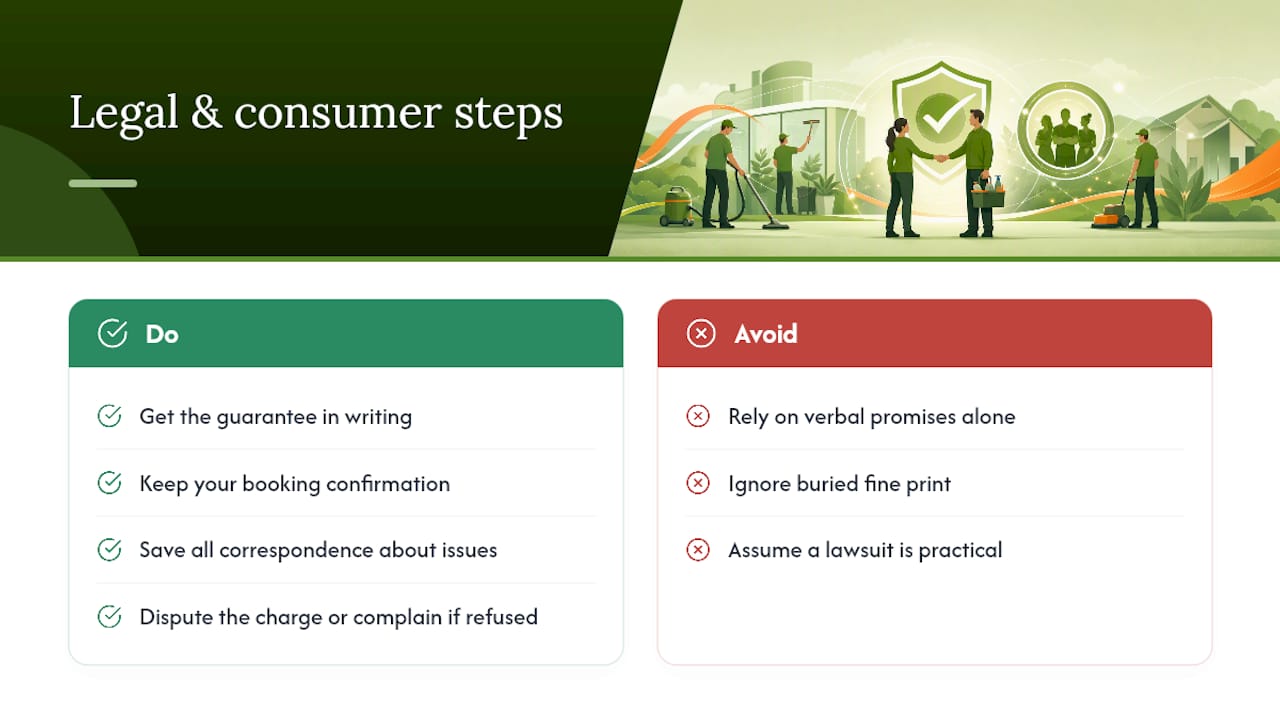
A cleaning service guarantee is a contractual promise, and like any contract term, it’s enforceable to the extent it’s actually written down. If a company verbally promises “100% satisfaction” but the signed agreement says nothing about remedies, you’re relying on the company’s goodwill, not a legal right. That gap matters most when a dispute gets heated.
Consumer protection law in most Canadian provinces requires that service providers deliver work of reasonable quality and that contract terms be presented in a way that isn’t misleading. A guarantee that’s advertised prominently but contradicted by buried fine print can run into problems with provincial consumer protection standards, though enforcement varies and pursuing a formal complaint is rarely worth it for a single missed cleaning visit.
Practically, your strongest protection isn’t a lawsuit, it’s a paper trail. Keep the written guarantee, your booking confirmation, and your correspondence about the issue. If a company refuses a reasonable remedy under its own stated terms, you generally have grounds to dispute a credit card charge or file a complaint with a provincial consumer affairs office. For larger commercial contracts, it’s worth having a lawyer review the guarantee and liability clauses before signing, since janitorial agreements sometimes bundle indemnification language into what looks like a simple satisfaction clause.
How guarantee policies differ across residential, commercial, and specialized cleaning
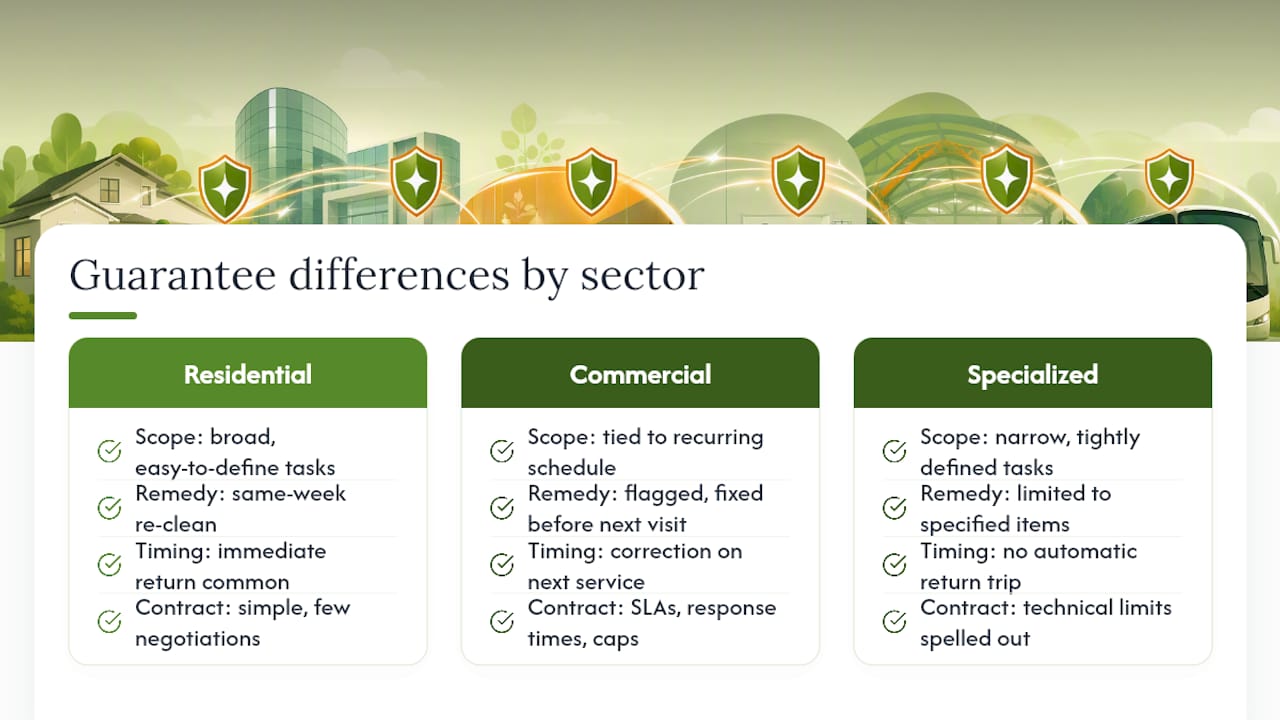
The same guarantee language doesn’t translate cleanly across every type of job. Residential guarantees tend to be the most straightforward: a missed room or a dusty baseboard is easy to define and easy to fix with a same-week re-clean.
Commercial contracts work differently because the stakes and the paperwork are bigger. A janitorial program covering an office might tie its guarantee to a recurring schedule, where a missed task gets flagged and corrected before the next visit rather than triggering an immediate return trip. Property managers overseeing multiple sites often negotiate service-level terms directly into the contract, spelling out response times and remedy caps in more detail than a typical residential agreement ever would.
Specialized services, like post-construction cleanups, move-out cleans, or medical and dental office cleaning, usually carry the narrowest guarantees of the three. The scope is tightly defined because the work itself is technical: a post-construction guarantee might only cover dust and debris removal, not the drywall dust that resettles from ongoing work nearby. If you’re booking a move-in or move-out clean, ask specifically how the guarantee treats landlord walkthrough disputes, since that’s a common friction point that generic guarantee language rarely addresses.
Why we publish our terms instead of just our promise
Most guarantee disputes come from ambiguity, not bad intentions. That’s why Atelier Maids ties its guarantee to something concrete: a written service report after every visit and a dedicated crew who knows your space well enough to get it right the first time.
Consistent teams and flat pricing don’t just make cleanings smoother, they remove most of the arguments before they start. Our side of the deal is simple: document what went wrong, tell us within our reporting window, and let us send someone back before you write the visit off.
— Atelier
Book a cleaning backed by a real guarantee
Atelier Maids offers a straightforward promise: if a visit falls short, we send the same crew back to fix it, and we stand behind the work with a full satisfaction guarantee, not a vague marketing line. That’s the practical difference between hiring a rotating cast of subcontractors and working with a dedicated crew who already knows your space and leaves a written report behind every time.

Every team is insured and background-checked, and every job comes with flat pricing, so there’s no guessing about what a re-clean or a follow-up visit will cost you. Whether you need a one-time house cleaning or a recurring office cleaning program across the GTA, take a look at our services page and request a quote to see exactly what’s included before you book.
Sources
Reviewing a provider’s actual terms, not just their homepage promise, is the single best habit you can build before booking any cleaning service. A few pages worth comparing for policy structure:
- Cleaning Service Guarantees: What to Do - CleanersRated
- Should Your Company Offer A Service Guarantee? — The Janitorial Store
Read the fine print before you sign, not after something goes wrong.